Thirteen Days of Despair: Why Bitcoin’s $87K ‘Extreme Fear’ Is a Contrarian’s Dream
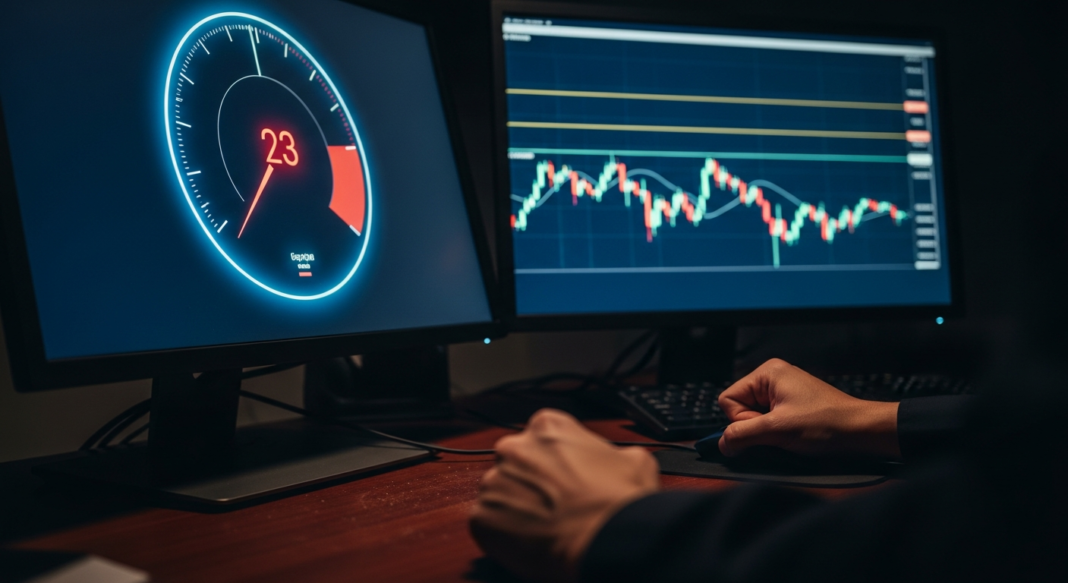
Thirteen days. That is how long the Bitcoin market has been holding its breath, waiting for a shoe to drop that hasn’t quite hit the floor yet. While the rest of the world was busy unwrapping gifts and arguing with relatives over Christmas dinner, the crypto market was staring at a screen that flashed a cold, hard number: 23. That’s the current reading on the Bitcoin Fear & Greed Index, and it puts us firmly in the “Extreme Fear” territory.
To the uninitiated, seeing “Extreme Fear” while Bitcoin hovers around $87,500 might seem like a paradox. After all, if you told a trader in the dark days of 2022—when we were scraping the sub-$20,000 barrel—that we’d be “terrified” at nearly ninety grand, they’d have asked what you were smoking. But market sentiment isn’t about absolute price; it’s about momentum, expectation, and the creeping dread that the party is over before it truly began. I’ve lived through the 2017 ICO craze and the 2022 FTX implosion, and if there’s one thing I’ve learned, it’s that the market is most dangerous when it’s bored, and most profitable when it’s scared.
The Anatomy of Anxiety: How the Index Reads Your Mind
Before we dismiss this 13-day streak as just another “crypto vibe,” we need to look at what actually moves the needle on the Fear & Greed Index. This isn’t just a Twitter poll; it’s a weighted composite of five distinct data points that offer a snapshot of the market’s collective nervous system. If you want to understand why we’re at a 23, you have to look at the plumbing:
- Volatility: Current volatility is compared against the average of the last 30 and 90 days. Sudden spikes in volatility are often interpreted as a sign of a fearful market.
- Market Momentum/Volume: High buying volumes in a positive market suggest greed; conversely, if volume is stagnant while prices consolidate, the index interprets it as a lack of conviction.
- Social Media Sentiment: The index scrapes keywords and hashtags on social platforms. When “Bitcoin” is trending alongside words like “crash,” “scam,” or “over,” the needle moves toward fear.
- Dominance: This is a classic “flight to safety” metric. When Bitcoin dominance rises, it often means investors are fleeing “riskier” altcoins to hide in the relative stability of the king, which ironically signals fear in the broader ecosystem.
- Google Trends: The index looks at search volume. High search volume for “Bitcoin” used to mean greed, but nowadays, a spike in searches often signals a panic-driven crowd looking for “how to sell Bitcoin.”
Right now, Bitcoin is sitting at $87,500, virtually unchanged from a week ago. This sideways chop is exactly what feeds the “Extreme Fear” beast. In crypto, if you aren’t mooning, people assume you’re dying. The retail crowd, which chased the pump to $80k, is now sitting on their hands, terrified that the consolidation is just a giant “bear flag” waiting to collapse.
Market Memory: History Doesn’t Repeat, But It Rhymes
If you’ve been around since the Mt. Gox days or even the “DeFi Summer” of 2020, you know that extended periods of extreme fear are often the precursor to a massive relief rally. Look back at the price low in November—the one that has served as our current cycle bottom. That low didn’t happen when everyone was cheering; it happened during a similarly grueling stretch of extreme fear.
The problem is that “Extreme Fear” can be a trap for the impatient. During the 2022 bear market, we saw the index stay in the single digits for weeks as the industry’s largest players—Luna, Celsius, Voyager—collapsed like a deck of cards. The current 13-day streak at 23 is uncomfortable, but it lacks the systemic “blood in the streets” feel of previous crashes. This feels more like a psychological exhaustion. The “Moonboys” who expected $100,000 by Christmas are disappointed, and that disappointment is being priced in as fear.
Historically, the best time to enter a position is when the index is below 25. It’s a simple contrarian play: buy when the crowd is looking for the exit. However, the caveat is that “Extreme Fear” can always become “More Extreme Fear.” A reading of 23 is low, but the index has hit 6 before. In a market where $87,500 is the new baseline, a 10% correction would feel like a catastrophe to those who entered at the top, even if the macro trend remains intact.
The Consolidation Trap and the Path Forward
The current price action of Bitcoin is a textbook example of “exhaustion.” We’ve seen the asset float around $87,500, failing to make new highs but refusing to break down. This is the “no man’s land” of trading. For the Bulls, the lack of upward momentum is frustrating. For the Bears, the resilience of the $85k support level is infuriating.
What’s different this time compared to previous cycles is the institutional layer. Unlike the 2017 bubble, which was fueled by retail FOMO and sketchy ICOs, the current price floor is reinforced by ETFs and corporate balance sheets. These players don’t care about the Fear & Greed Index; they care about quarterly reports and macro liquidity. The fear we’re seeing is likely retail-driven—the same retail investors who are currently underwater on their high-leverage “long” positions.
If history is our guide, this 13-day streak is reaching its expiration date. Markets can only stay this tense for so long before a volatility expansion occurs. Usually, when the crowd is leaning this heavily into fear, the market takes the path of most pain: a “short squeeze” that sends prices soaring, forcing the doubters to buy back in at higher prices.
Risk Assessment: Why the Fear Might Actually Be Right
Now, I wouldn’t be doing my job if I didn’t play devil’s advocate. Is it possible the fear is justified? Absolutely. We are navigating a global macro environment that is far more hostile than the one that birthed Bitcoin. Interest rates remain a looming shadow, and regulatory scrutiny has never been higher.
The risks are real:
- Liquidity Thinning: Over the holidays, trading volume typically drops. Thin markets are easier to manipulate. A single large “market sell” order could trigger a cascade of liquidations that the Fear & Greed Index is already sensing.
- The $100K Psychological Barrier: Bitcoin has been staring at the six-figure mark for a while. The longer we fail to break it, the more it becomes a “ceiling of doom” rather than a target.
- Altcoin Bleeding: While BTC stays flat, altcoins are being decimated. This divergence often precedes a broader market correction as investors sell their BTC to cover losses elsewhere.
Treat this as financial analysis, not a signal to bet the house. The Fear & Greed Index is a lagging indicator—it tells you how people *felt* yesterday. While “Extreme Fear” has historically marked bottoms, there is no law that says a bottom can’t drop further. If you’re a long-term believer, this 13-day streak is a footnote. If you’re a high-leverage swing trader, it’s a warning: the market is coiled like a spring, and it doesn’t care about your Christmas spirit.