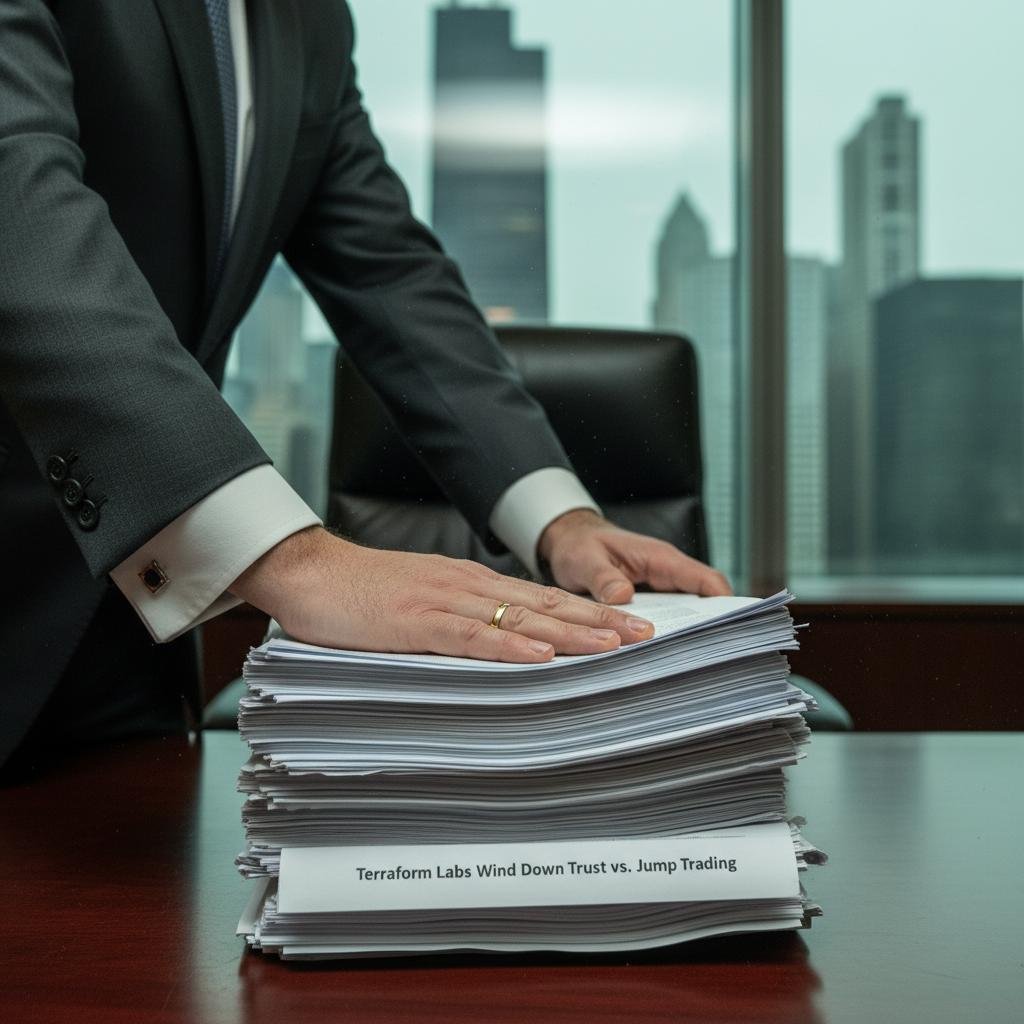
$4 Billion Blame Game: Terraform Administrator Goes After Jump Trading
Just weeks after Terra founder Do Kwon got hit with a 15-year prison sentence, the plot thickens. The administrator charged with picking up the pieces from the $40 billion Terra implosion, Todd Snyder, isn’t messing around. He just slapped Jump Trading with a staggering $4 billion lawsuit, accusing the Chicago-based trading giant of market manipulation, defrauding investors, and self-dealing. This isn’t just another crypto squabble; it’s a direct shot at one of crypto’s most powerful, and often secretive, firms, claiming they played an “outsized role” in the cataclysmic 2022 collapse.
The lawsuit, filed by the Terraform Labs Wind Down Trust, pulls no punches. Snyder’s office took to X, declaring their intent to “hold Jump to account” and “recover value for creditors,” asserting that Jump “exploit[ed] the ecosystem, leaving unsuspecting investors to bear the losses.” Talk about a mic drop.
The Secret History: How a “Gentleman’s Agreement” Allegedly Blew Up Crypto
To understand the depth of these accusations, you need to rewind to the turbulent days of Terra. Its stablecoin, UST, was supposed to hold a perfect $1 peg through a complex dance with its sister token, LUNA. When UST dipped, LUNA got burned, creating arbitrage opportunities that theoretically pulled UST back to parity. It was an elegant, if ultimately flawed, design that attracted billions.
But here’s where Jump allegedly stepped in, far beyond the typical market maker role. The lawsuit claims a “gentleman’s agreement” existed between Do Kwon and Kanav Kariya, then head of Jump Crypto. This wasn’t just about facilitating trades; it was about Jump actively maintaining the UST peg. And they allegedly did so in secret.
The first major test came in May 2021, when UST briefly de-pegged to $0.90. Panic stations. According to the lawsuit, Kwon and Kariya cut a deal: Jump would buy UST until it re-pegged. In exchange, Terraform would waive vesting requirements on the LUNA tokens Jump was set to acquire at a heavily discounted price ($0.40 per token, compared to market value). This was a sweet deal for Jump, but it had a catch: they couldn’t immediately cash out. They needed Terra to stay afloat long enough to receive their allocated LUNA, which was set to drip-feed until September 2025.
The plan worked. UST recovered. But instead of fessing up that the “algorithmic stability” had needed a multi-million-dollar lifeline from a high-frequency trading firm, Kwon and Kariya allegedly spun a narrative of unmitigated success. The secret was paramount, the lawsuit argues, because it kept the illusion of UST’s inherent strength alive, allowing Jump to continue accumulating its deeply discounted LUNA and, eventually, profit hand over fist. Even most Terraform employees were reportedly kept in the dark about Jump’s covert rescue mission.
The LFG Riddle and the Final Implosion
The plot thickens with the Luna Foundation Guard (LFG), an entity ostensibly created to defend UST’s peg with a vast treasury of crypto assets. The lawsuit claims LFG was anything but independent, with Kwon and Kariya allegedly calling the shots. Terraform gifted LFG billions in LUNA tokens, which LFG then sold for other cryptocurrencies, including Bitcoin. But who was buying? Allegedly, Jump Trading, at a whopping 40% discount to market value.
Fast forward to May 2022. UST started to crumble again, this time for good. The lawsuit alleges that LFG transferred its substantial Bitcoin holdings to Jump to deploy in defending the peg. But without any formal agreement, “it is not clear how Jump used that Bitcoin, and whether it did so in ways that further lined its own pockets,” the lawsuit reads. While Jump’s executive William DiSomma allegedly tried to rally other trading firms, those firms reportedly smelled blood in the water, trading against UST and LUNA, accelerating the inevitable.
The result? A $40 billion inferno that scorched retail investors globally and triggered a domino effect, toppling several multi-billion-dollar crypto firms. While Kwon now sits in a prison cell, Snyder’s lawsuit argues that the Jump executives who allegedly facilitated this grand deception have, until now, evaded accountability.
“Baseless” Accusations? Jump Fires Back
Of course, Jump isn’t taking this lying down. A spokeswoman for the firm swiftly dismissed the allegations as “baseless” in a statement to the Wall Street Journal, framing the lawsuit as a “desperate attempt by Terraform Labs to shift blame and financial responsibility away from the crimes that Do Kwon committed.”
It’s a classic he-said, she-said, but with billions on the line. Jump Trading, a venerable firm founded in 1999 by derivatives pit traders, built its empire on high-speed trading before diving headfirst into crypto in 2021, quickly becoming a major market maker and investor. Now, their reputation and coffers are under an unprecedented attack. While a Jump subsidiary, Tai Mo Shan, did pay a $123 million fine to the SEC in 2024, that’s a fraction of the $4 billion Terraform and Kwon were ordered to pay after their own SEC loss.
This lawsuit isn’t just about past wrongs; it’s about setting a precedent for accountability in the wild west of crypto. It asks a crucial question: when does a market maker’s aggressive trading strategy cross the line into market manipulation and fraud, especially when the lines between “support” and “exploitation” become so blurry? The crypto world will be watching this one very, very closely.