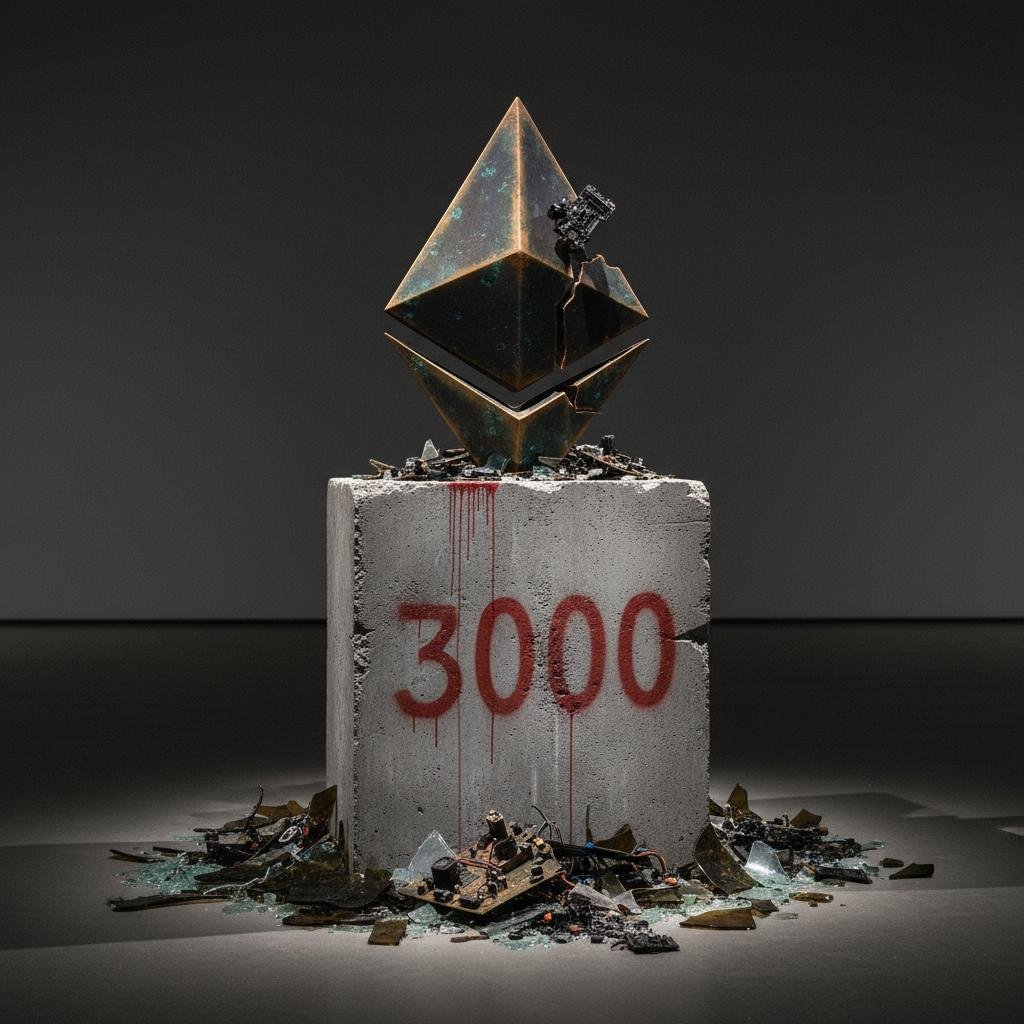
Another Day, Another Crypto Carnage
Well, here we go again. Ethereum, the supposed bedrock of DeFi and NFTs, just pulled a classic crypto move: dumping below the psychologically significant $3,000 mark. And it didn’t do it quietly. We’re talking about a sharp sell-off that sent ETH hovering precariously between $2,900 and $2,950, shedding 5-7% in a mere 24 hours. The market cap? Slipping towards the mid-$340 billion range. For anyone watching the charts, it felt less like a gentle correction and more like a rude awakening.
But the real headline wasn’t just ETH’s individual slide. This wasn’t some isolated incident. The broader crypto market saw a brutal cleansing, with nearly $600 million in leveraged positions – across the board – flushed out in a single, gut-wrenching day. Six hundred million dollars. Poof. Gone. That’s not just price action; that’s a lot of traders getting margin called into oblivion. It’s a stark reminder that in crypto, leverage is a double-edged sword, and when the market decides to turn, it turns fast and it turns viciously.
What triggered this sudden capitulation? According to some sharp market observers, a significant portion of this derisking happened ahead of the Bank of Japan’s interest rate decision. Yes, global macro still dictates the crypto beat, whether we like it or not. When central banks cough, crypto often catches a cold – or, in this case, a nasty fever that triggers a wave of forced selling.
Why ETH Said Goodbye to $3K
For the uninitiated, Ethereum is supposed to be the big dog, the second-largest crypto network by market cap, the platform powering virtually everything from decentralized finance to digital art. So, when ETH busts through a key level like $3,000, it sends shivers through the entire market. It’s not just an Ethereum problem; it’s a ‘what does this mean for everything else?’ problem.
This latest tumble, around 6.9% to roughly $2,904, was a direct result of that $592 million liquidation event. But let’s be honest, the cracks were showing long before yesterday’s crash. This fragile structure started back in November, when Ether already kissed $3,590 goodbye on a staggering 138% above-average selling volume. That wasn’t just profit-taking; that was conviction selling. It signaled that the market was already looking for reasons to bail, and it found one.
Short-term traders, the ones glued to their screens, had been eyeing the $2,820-$2,830 zone with bated breath. This little pocket, marked by MVRV deviation bands, has historically acted as a kind of on-chain shock absorber. Think of it as a safety net that’s caught falling knives before. The fact that it’s being watched so closely now tells you everything about how nervous the market is. Since 2016, a drop in the MVRV Z-Score below 0 has often flagged prime accumulation times for ETH. It’s currently at 0.29 – not quite ‘buy everything’ territory, but certainly flashing a warning that we’re far from euphoria.
Despite the recent bounces around this band, suggesting some stubborn optimists are still trying to catch that knife, the broader sentiment has decidedly turned cautious. On the intraday charts, ETH is now firmly below its 100-hour simple moving average, with a clear bearish trend line at $3,120 acting as a ceiling for any recovery hopes. The technicals, frankly, look grim.
The Ripple Effect: Beyond Ethereum’s Chart
Let’s not pretend Ethereum’s woes are happening in isolation. Bitcoin, the undisputed king, had its own moment of weakness, pulling back hard and triggering its own round of liquidations. This correlation isn’t new; we’ve seen this dance before. When BTC takes a hit, ETH usually follows, and this time was no different. It’s a reminder that for all the talk of independence, these two titans are still heavily tethered.
Adding to ETH’s pain is the rising tide of competition. Solana, Avalanche, Polygon – a whole host of altchains are clamoring for attention, promising faster transactions, lower fees, or simply a shinier new narrative. During risk-off periods, speculative capital, always fickle, tends to rotate out of established plays like ETH and into these ‘higher-beta’ alternatives, searching for that next moonshot. It’s a constant battle for mindshare and, more importantly, developer and user attention. Ethereum’s dominance isn’t a given; it’s constantly being challenged.
What’s Next? Springboard or Trap?
So, what now? Is this sub-$3K level a launchpad for a quick rebound, or a devious trap ready to ensnare more eager buyers? The immediate hurdles are clear: resistance clusters around $2,980, then $3,050, and finally the $3,080–$3,120 band. A decisive, high-volume push above these levels could, theoretically, open the door to $3,175–$3,200. That’s the hopium scenario.
But let’s be real. Failure to reclaim $2,980 and $3,000 with conviction leaves ETH staring down a deeper abyss. We’re talking about a slide towards $2,920, then potentially $2,880–$2,840, with $2,800 standing as the last, critical line in the sand. Break that, and things could get genuinely ugly.
This drawdown also highlights Ethereum’s Achilles’ heel: its heavy reliance on leveraged futures and the whims of global macroeconomic risk appetite. Consider this: U.S.-traded ETH ETFs saw approximately $578 million in outflows in August 2025 alone. That’s institutions tactically reducing their exposure, pulling money off the table. Yet, in a classic crypto paradox, blue-chip institutions like JPMorgan are simultaneously launching tokenized money market funds (MONY) on Ethereum. So, some are bailing, while others are still building. It’s a mixed message, to say the least, reflecting the ongoing struggle for narrative control.
If ETH can’t defend these critical on-chain support zones, the long-held narrative of “Ethereum as the safe large-cap in DeFi” takes a serious hit. That opens the door wide for rivals to pitch themselves as faster, cheaper, and more exciting alternatives. It’s a battle for perception, and right now, price isn’t helping Ethereum’s case.
The Real Risks for Traders: Ditch the Hopium
The biggest mistake right now? Assuming that a break below $3,000 automatically guarantees a swift snapback. Hourly indicators tell a different story. The MACD on ETH/USD is still gaining momentum in the red, and the Relative Strength Index (RSI) sits stubbornly below 50. That’s sellers firmly in control, not some exhausted capitulation bounce waiting to happen.
With liquidations already through the roof, a second wave of forced selling is a very real threat if ETH loses those crucial $2,920–$2,880 supports. Think of it as a domino effect: one margin call triggers another, feeding into a death spiral. It’s happened before, and it can happen again.
Then there’s the narrative risk. Ethereum’s underlying usage and institutional experimentation might still look solid, but the price chart is screaming caution. When you see headlines questioning the “worst ETH bull runs” or rivals like Ripple openly targeting Ethereum’s market share, it amplifies fear, especially when the technicals are already weak. It becomes hard to distinguish genuine structural issues from mere leverage-driven price swings.
Volatility, as always, cuts both ways. A clean reclaim and hold above $3,080–$3,120 would suggest this was just a leverage flush within a larger trading range. But a daily close below $2,880? That strengthens the argument for a much deeper correction. Until the chart makes that choice, trying to call the exact bottom is a fool’s errand. Instead, focus on disciplined position sizing, clear invalidation levels, and an honest assessment of your own time horizon. That’s how you survive these markets, not by chasing every dip with blind optimism.