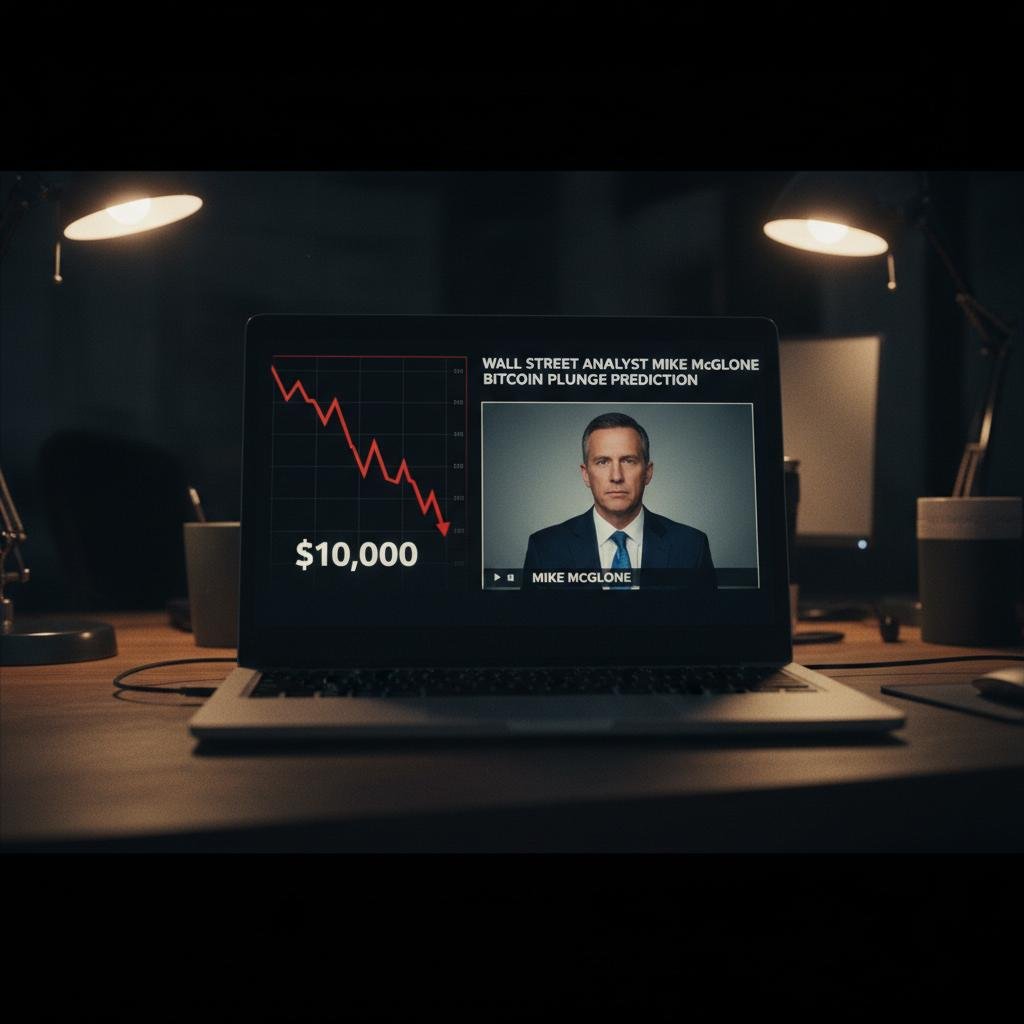
Brace Yourself: Wall Street Predicts Bitcoin’s Brutal Plunge to $10,000
Forget the moon. One Wall Street veteran thinks Bitcoin’s next stop might be closer to a crater – a brutal 90% drop to $10,000 by 2026. Yes, you read that right. While many crypto enthusiasts are still dreaming of six-figure Bitcoin, Mike McGlone, the senior commodity strategist at Bloomberg Intelligence, just dropped a bombshell prediction that could make even the most hardened hodler wince.
McGlone isn’t pulling punches. He sees the flagship cryptocurrency hemorrhaging value, tumbling from its peak of $126,000 to a shocking $10,000. That’s a nearly 90% wipeout from its all-time high, painting a grim picture for the coming years. His LinkedIn post laid it out: “Bitcoin’s rally above $100,000 may have sparked a cycle back toward $10,000, potentially in 2026.”
The ‘Post-Inflation Deflation’ Theory: 2008 Redux?
So, what’s driving this doomsday forecast? McGlone points to a phenomenon he calls “post-inflation deflation.” Think of it as the ultimate hangover after an epic, inflation-fueled party. It’s a period where asset prices don’t just cool off; they slam into reverse after an extended period of rising costs. He sees parallels to the pre-2008 financial crisis, writing in a Bloomberg Terminal note: “Falling Bitcoin may mirror 2007 stocks vs the Fed.”
His core argument rests on what he terms “wealth-creation reversion.” In simpler terms, speculative bubbles burst. And according to McGlone, the crypto market, with its “highly speculative, unlimited-supply digital assets — most of which track nothing,” is ripe for a significant correction. He believes this unwinding of speculative wealth could be the primary catalyst for the next recession.
Consider the implications of such a scenario. If McGlone is correct, it suggests that the massive influx of capital into crypto, driven by narratives of quick riches and a hedge against inflation, might be facing a dramatic reversal. This isn’t just a minor pullback; it’s a structural reset where assets that gained significantly during an inflationary boom could see their values decimated in a subsequent deflationary bust. For traders and investors, understanding this potential paradigm shift is crucial, as strategies built on continuous growth might suddenly find themselves underwater.
Bitcoin’s Current Wobbly Stance
McGlone’s latest warning hits as Bitcoin already looks a little green around the gills. The top crypto is currently trembling near $90,000, a not-insignificant 30% drop from its all-time high set back in October. December wasn’t much better, with BTC mostly stuck between $85,000 and $95,000. Year-to-date, Bitcoin is down a solid 13%.
Compare that to the old guard. The S&P 500, America’s broad stock market index, is up a respectable 17% this year. Gold, the ultimate safe haven, has absolutely crushed it, soaring 64% in 2025. This divergence is stark. While traditional assets found their footing and even thrived, Bitcoin has been left in the dust, underperforming significantly. This weak performance, combined with McGlone’s long-standing bearish stance – he predicted a drop to $50,000 just last November – adds weight to the idea that the bull market might be on a longer hiatus than many hope.
The sentiment on the ground isn’t exactly screaming “buy the dip” either. Coinglass data from the past 24 hours shows a bloodbath for bullish traders, with a staggering $230 million in Bitcoin long positions liquidated. Meanwhile, shorts, those betting on a price drop, saw only $60 million wiped out. This imbalance suggests many traders anticipating a breakout higher were caught completely flat-footed, highlighting the market’s current fragility and the dominance of bearish momentum in short-term trading.
Even institutional money seems hesitant. After a brutal November that saw $3.5 billion in Bitcoin ETF sell-offs, last week brought a meager $287 million inflow, according to DefiLlama. While any inflow is better than an outflow, it’s a trickle compared to the torrent of selling just weeks prior. This hesitant return of institutional capital suggests a deep-seated caution, indicating that even big players aren’t convinced the bottom is in or that a swift recovery is imminent.
The Macroeconomic Headwinds: A Storm on the Horizon?
This isn’t just about crypto; it’s about the entire global economy. This week is shaping up to be a monumental one on the macroeconomic front, with central banks from Europe, the UK, and Japan all making critical rate decisions. These decisions will ripple through global markets, influencing everything from bond yields to investor confidence. Any hawkish surprises could further dampen enthusiasm for risk assets like Bitcoin.
In the US, markets are still reeling from the Federal Reserve’s December 10th meeting. The Fed slashed interest rates by 0.25%, bringing them to a three-year low. But it wasn’t just the cut that spooked markets; it was the rare admission from Chairman Jerome Powell that job growth might have been “overstated for months.” Three dissenting votes on the rate cut further underscored the deep divisions within the Fed about the true state of the economy.
This admission is far more significant than it appears on the surface. If the official employment numbers have been inflated, it means the labor market is weaker than previously thought. A weaker labor market directly impacts consumer spending and overall economic growth, making a recession more likely. This uncertainty forces the Fed into a difficult position: keep cutting rates to stimulate a flagging economy, or pause to combat lingering inflation fears, even if those fears are based on potentially flawed data.
As Ed Yardeni, president of Yardeni Research, succinctly put it: “This week is loaded with long-delayed government data releases, including on employment and inflation, which will provide a reality check on the economy’s performance in the final weeks of 2025.” These “reality checks” are precisely what McGlone’s “post-inflation deflation” theory hinges upon. If the data confirms a weakening economy and persistent deflationary pressures, the case for a significant asset price correction, especially in speculative sectors, only grows stronger.
The interplay between these macro factors and crypto is direct. When global economic uncertainty rises, investors tend to flee riskier assets for safer havens. Bitcoin, despite its proponents’ claims of being “digital gold,” has largely behaved as a high-beta tech stock, correlating with broader market sentiment. If the Fed is genuinely worried about the economy and the rest of the world’s central banks follow suit with cautious or contractionary policies, the path of least resistance for Bitcoin could indeed be downwards.
The Long Shadow of Doubt
While Ethereum managed a modest 1.5% gain to hit $3,150 in the last 24 hours, and Bitcoin barely moved, down 0.1% to $89,900, these minor fluctuations offer little solace in the face of such a dire long-term prediction. McGlone’s call isn’t just another bearish whisper; it’s a loud, clear warning from a respected voice on Wall Street, echoing the sentiment that the party might truly be over for highly speculative assets.
Is this just another attention-grabbing headline, or is there genuine substance to McGlone’s “post-inflation deflation” thesis? History, particularly the economic cycles leading up to 2008, offers a stark reminder that what goes up can, indeed, come crashing down. For crypto traders and Web3 enthusiasts, the next few years might demand a level of caution and strategic re-evaluation rarely seen in the market’s often euphoric past. The question isn’t just if Bitcoin can hit $100,000 again, but if it can avoid crashing back to $10,000 first.