The ‘Digital Gold’ Narrative Hits a Reality Check
Bitcoin is currently learning a painful lesson in market physics. After teasing the masses with a run toward $110,000, the orange coin has spent the last few weeks choking on its own exhaust. While the Twitter bulls were busy printing “Bitcoin $200k” hats, the reality on the ground shifted. Bitcoin is now gasping for air around the $87,000 to $88,000 range, and the “digital gold” narrative—the very foundation of the 2024 institutional pivot—is looking a bit shaky.
For those of us who lived through the 2017 blow-off top and the 2022 FTX-induced funeral, this pattern feels uncomfortably familiar. It’s the “range-bound chop” that grinds retail traders into dust. But what makes this moment unique isn’t just that Bitcoin is stalling; it’s that actual, physical gold and silver are sprinting past it. While Bitcoin traders are fighting over $90k resistance, precious metals are breaking out, fueled by the kind of geopolitical dread and interest rate uncertainty that Bitcoin was supposed to thrive on. Instead, capital is flowing into the shiny rocks of the old world, leaving BTC to behave like a high-beta tech stock on a bad day.
Gold Proves It’s Still the King of Chaos
The divergence we’re seeing right now is a structural gut punch for the crypto-maximalist thesis. According to fresh data from XWIN Research Japan, Bitcoin is stuck in a consolidation phase characterized by a high-level correction and downward-tilted momentum. In contrast, gold and silver are catching a bid because institutional money still views them as the ultimate defensive bunkers. When the world gets messy—whether it’s through policy shifts or geopolitical sparks—big money goes where it knows the exits are clearly marked and the liquidity is deep.
Silver, often the more volatile cousin of gold, has been amplifying these moves. It’s benefiting from a combination of tight supply and speculative flows that would normally be finding their way into the crypto markets. The problem for Bitcoin is that it still carries the “risk asset” tag. In a “risk-off” environment, investors don’t run toward the asset that can drop 10% on a Sunday afternoon; they run toward the asset that has been a store of value for five millennia. Institutional capital can allocate to gold with the flick of a switch, backed by decades of regulatory clarity that the crypto industry is still begging for.
The Technical Graveyard: MAs and Underwater Holders
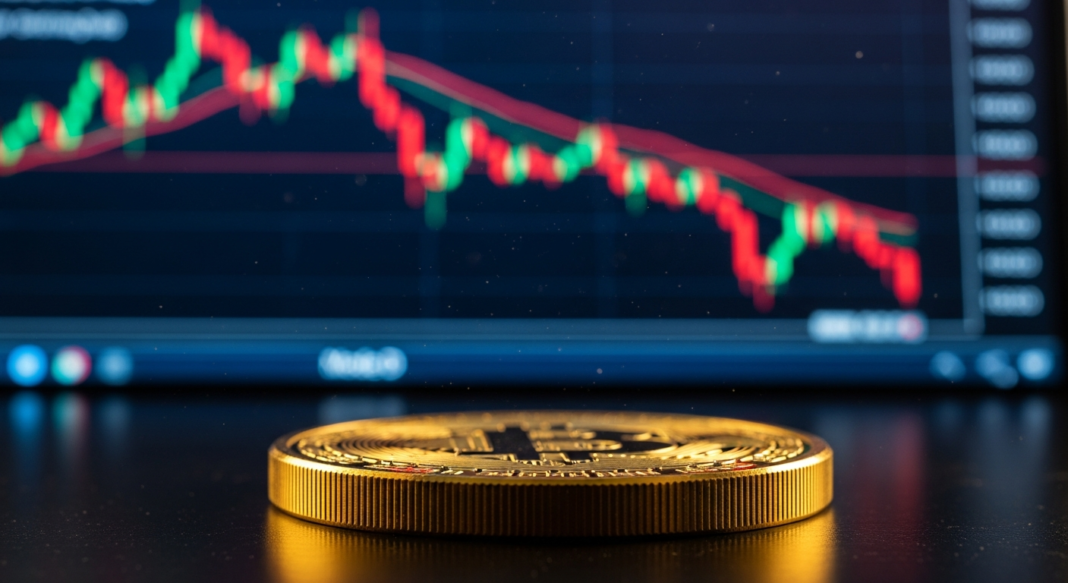
If you want to know why the price keeps hitting a ceiling at $90,000, you have to look at the chart. Bitcoin has decisively lost its short-term bullish structure. It’s currently trading below its 50-day moving average (the blue line for the chart nerds), and more importantly, that average has started to slope downward. In market terms, that’s a “sell the rip” signal. Every time the price tries to poke its head back above $90k, it’s met by a wall of supply from traders who bought the top and are just looking to get out at breakeven.
We are now testing the 100-day moving average, sitting just above the current price. This has been the dynamic floor for much of this cycle. If it holds, we might see a base form. If it fails, the next stop is the 200-day moving average, which is currently lurking in the low $80,000s. The volume profile tells the real story: the sell-off from the $110,000 peak was high-volume distribution. The subsequent “recovery” attempts have been on low volume, suggesting a lack of conviction from the big players. This isn’t a “shallow pullback” anymore; it’s a battle for the trend itself.
SOPR and the Psychology of Losing Money
To understand the “Expertise” side of this mess, we have to talk about the Short-Term Holder SOPR (Spent Output Profit Ratio). Data from CryptoQuant shows this metric has been hovering below 1. For the uninitiated, when SOPR is below 1, it means short-term participants—those who bought within the last 155 days—are selling their Bitcoin at a loss. This is the definition of “capitulation-lite.”
When people are selling at a loss, it creates a psychological drag on the market. It means the “new money” that entered during the ETF hype is currently underwater and feeling the heat. Unlike the “diamond hand” whales who have been holding since $10k, these participants have a low pain tolerance. Their exit liquidity becomes the overhead resistance that prevents Bitcoin from following gold into new all-time highs. Furthermore, “apparent demand”—a metric that tracks the difference between block rewards and the change in inactive supply—has turned negative. This means we aren’t seeing fresh capital enter the system; we’re just seeing the same coins being shuffled around by tired hands.
Historical Context: This Isn’t 2021 (Yet)
Market memory is a powerful tool. In 2021, we saw similar periods where Bitcoin would decouple from the macro environment, only to snap back violently once the leverage was flushed out. However, the current setup mirrors the post-hype exhaustion we saw in the mid-2021 “China Ban” era or the slow bleed of 2018. The difference today is the institutional presence. With the ETFs live, Bitcoin is more tethered to the traditional financial system than ever before. If BlackRock’s clients are seeing gold outperform BTC, the “digital gold” pitch becomes a harder sell in the short term.
Bitcoin’s role as a high-beta asset means it needs “risk-on” sentiment to thrive. It needs the Nasdaq to be ripping and the Fed to be signaling a liquidity party. When those factors are absent, and gold is the only thing moving, Bitcoin sits on the sidelines. It’s the second or third consideration for a portfolio manager, not the first. Until Bitcoin can prove it can stay stable while everything else is on fire, it remains a secondary play for the “smart money.”
Risk Assessment: A Bear Market in Disguise?
The biggest risk right now is that this isn’t just a “correction,” but a regime change. Some analysts are already calling for a prolonged bear market. While that might sound like hyperbole, the data doesn’t lie: demand is drying up, and momentum is fading. If the 200-day moving average fails to hold, the $70k level becomes the next psychological battleground, and the euphoria of the early year will feel like a distant dream.
The bull case relies entirely on “apparent demand” turning positive and the STH SOPR reclaiming a level above 1. We need to see people buying Bitcoin because they want it, not just because they’re hoping to flip it to the next guy. Until that happens, the prudent move is to watch the metals. Gold and silver are currently doing what Bitcoin promised to do. For traders, that’s a signal you can’t afford to ignore. This is a market for patience, not for chasing the “next leg up” that may not arrive until the macro storm clears. Treat this as a structural reset—because that’s exactly what it looks like.