The Bitcoin Price Dream Just Got Two Years Longer
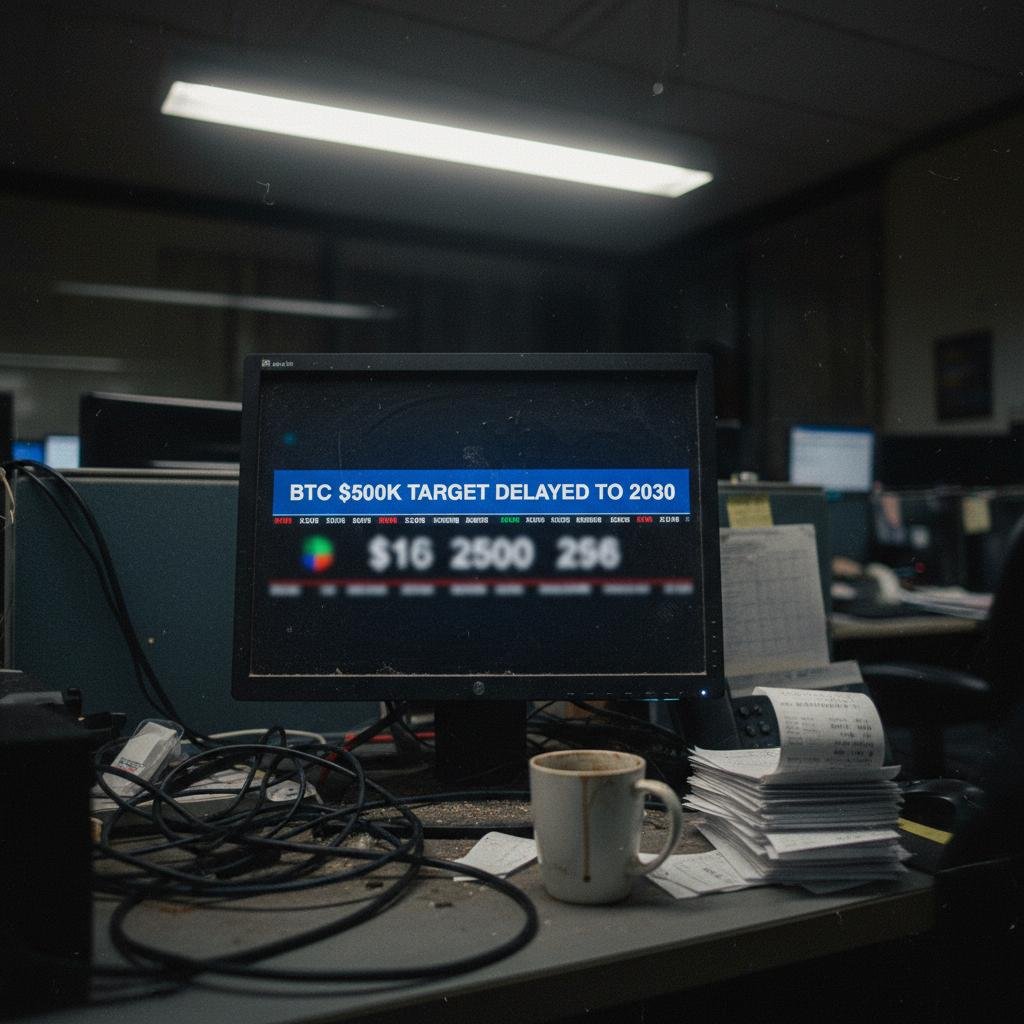
Remember that seemingly inevitable march to $500,000 Bitcoin by 2028? Yeah, well, Standard Chartered just pumped the brakes. The UK banking giant, never one to shy away from bold crypto predictions, just pushed that half-million-dollar target back. Mark your calendars for 2030, folks. Not 2028. Why the sudden recalibration? Geoffrey Kendrick, Standard Chartered’s global head of digital assets research, laid out three structural shifts forcing the firm to pull back its bullish outlook. And honestly, it’s a reality check a lot of the market needed.
This isn’t just some idle adjustment. Bitcoin has taken a beating, shedding nearly 40% from its October 6 all-time high, plummeting all the way down to $90,000. Sure, long-time HODLers will tell you that’s par for the course for Bitcoin, especially since the US spot ETFs hit the market two years ago. Volatility is its middle name. But when a major bank revises its timeline, it sends a shiver through the narrative. It means the market’s usual “up and to the right” mentality might need a serious rethink.
The Party’s Over for Digital Asset Treasury Buying
The first, and arguably biggest, reason for Standard Chartered’s revised forecast is a cold splash of water on the “digital asset treasury” (DAT) buying frenzy. Kendrick put it bluntly: “We think buying by Bitcoin digital asset treasury companies is likely over.”
Think back to 2020. Michael Saylor and MicroStrategy kicked off a trend, buying Bitcoin as a corporate treasury asset. It was revolutionary. Then, this year, that trend exploded. Companies like Metaplanet and Twenty One Capital followed suit, raising capital specifically to load up on Bitcoin. The genius? Their equity traded at insane premiums to their actual Bitcoin holdings – sometimes 200% or more. This allowed them to issue new shares, effectively creating money out of thin air to buy more Bitcoin without diluting existing shareholders. It was a self-feeding loop, a perpetual motion machine for accumulating sats.
But every party has to end. Those massive premiums? They’ve evaporated. Poof. Gone. MicroStrategy, the OG, now trades at a 15% *discount* to its Bitcoin holdings. Metaplanet, once boasting a 230%+ premium, is now barely over 7%. Some treasuries are staring down nearly $1 billion in unrealized losses. Without these fantastical premiums, the entire model crumbles. Companies can’t just conjure capital to buy more Bitcoin. The easy money is gone. While Kendrick believes these treasuries are more likely to consolidate their holdings than sell them off, the era of companies using equity to vacuum up Bitcoin appears to be firmly in the rearview mirror. This matters because it removes a significant, consistent source of buy pressure that many in the market had taken for granted.
The Halving Cycle is Dead. Long Live… What?
For years, it was gospel. The Bitcoin halving, an event where mining rewards get sliced in half every four years, was the undeniable engine of the bull market. The script was simple: halving happens, prices surge for 12-18 months, new all-time high, then a brutal 70-90% crash into a multi-year bear market. Rinse, repeat. It held true for three cycles straight – 2012-2016, 2016-2020, 2020-2024. A predictable, almost cyclical rhythm to Bitcoin’s madness.
Except, according to Kendrick, not anymore. “We do not share the view that the halving cycle is still valid,” he states. And he’s not just whistling Dixie. Even Changpeng Zhao, the former Binance CEO, recently declared the halving cycle “seems to have ended.” Cathie Wood of Ark Invest, another prominent voice, agrees, telling Fox Business that the “four year cycle is going to be disrupted.”
Why the sudden shift in thinking? The argument is that institutional money, the kind flowing through those shiny new ETFs, fundamentally changes Bitcoin’s market dynamics. In previous cycles, retail FOMO and the supply shock from the halving were the primary drivers. Now, institutions are stepping in, potentially smoothing out the extreme volatility. If Bitcoin’s drops are becoming less severe (Wood points to a 35% drop versus the historical 70-90%), then the very nature of the boom-bust cycle is being altered. This isn’t just academic; it challenges a core tenet of Bitcoin investment strategy and calls into question how traders should approach future halving events. Forget the pre-programmed surges; the market might just be growing up, or at least, getting a lot less wild.
ETFs: The Sole Engine of Future Rallies?
With corporate treasury buying effectively over and the halving cycle fading into myth, what’s left to drive Bitcoin’s price? Standard Chartered has a stark answer: “We now think future Bitcoin price increases will effectively be driven by one leg only — ETF buying.”
Think about that for a second. The entire future of Bitcoin’s price appreciation, according to a major bank, now rests squarely on the shoulders of exchange-traded funds. It’s a huge bet, but not without merit. Despite the occasional dip in flows – even BlackRock’s IBIT saw some momentary outflows in November – the overall picture is one of relentless accumulation. The 11 approved spot ETF providers collectively hold north of $150 billion in Bitcoin. That’s a staggering 6.6% of the network’s total supply. And it’s only set to balloon. The latest bombshell? Vanguard, the $11 trillion asset manager, has done a complete U-turn and will now offer Bitcoin ETFs to its clients. This is massive. Vanguard’s client base represents a colossal pool of conservative, long-term capital that has, until now, been walled off from crypto exposure.
Standard Chartered believes these “longer-term ETF buyers are a much more important price driver.” This isn’t about chasing quick pumps; it’s about slow, steady institutional allocation that views Bitcoin as a legitimate portfolio asset. This shift means that Bitcoin’s price action is increasingly tied to the traditional financial world’s adoption cycles, regulatory approvals, and macroeconomic sentiment that influences large asset managers. It’s less about the niche crypto narratives and more about mainstream finance finally plugging in. This institutional absorption, while perhaps delaying the $500,000 mark, ironically provides a more robust, if slower, path to that valuation. Standard Chartered, despite the delay, still believes $500,000 is attainable, citing ongoing portfolio optimization where global portfolios remain “underweight Bitcoin” compared to gold. The destination might be the same, but the road just got a whole lot longer, and a lot less reliant on the old crypto hymns.