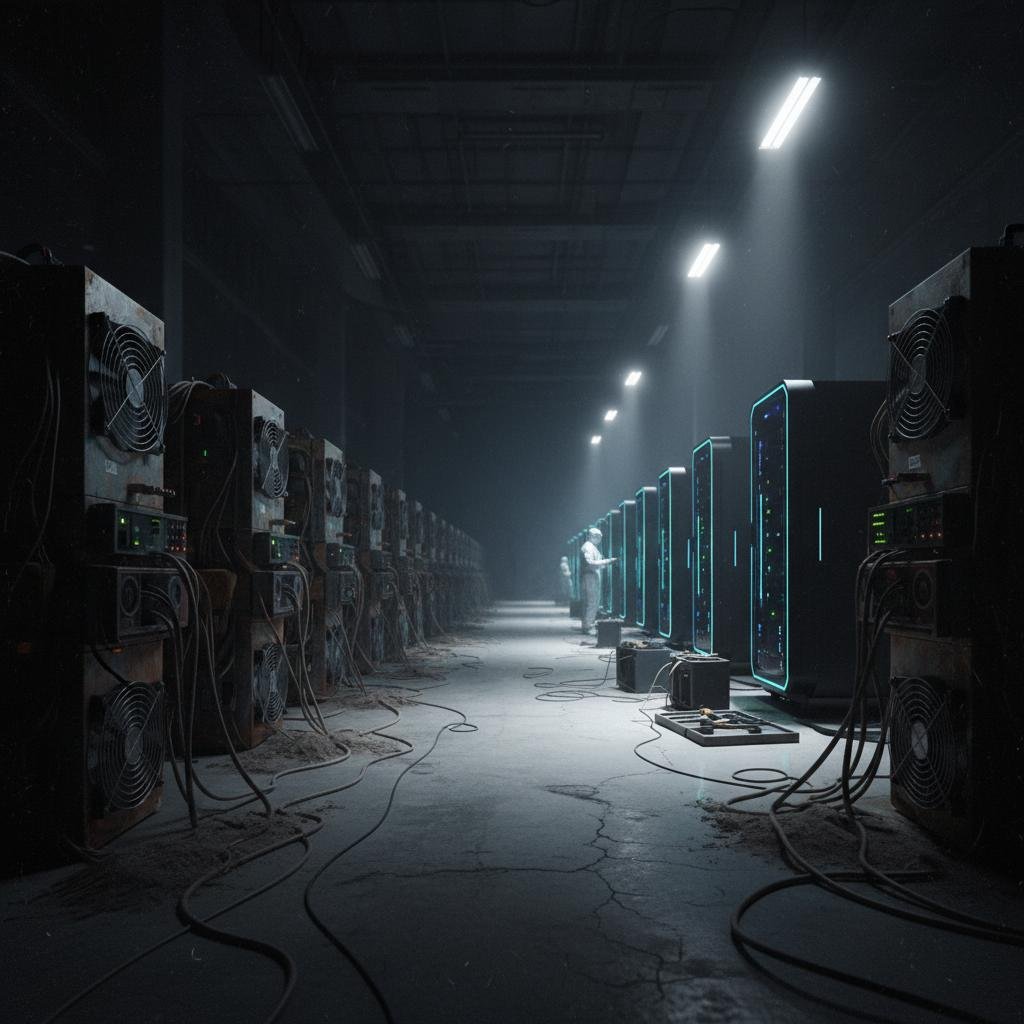
The Grim Reality for Bitcoin Miners
Let’s not mince words: Bitcoin miners are in a tough spot. You’ve seen the charts. The price of Bitcoin, while volatile as ever, has been clinging around $87,000 recently. That’s a good 30% whack below its October all-time high. For most top miners, Q3 saw them barely breaking even around $90,000 per BTC. Do the math. These aren’t healthy margins.
But the pain doesn’t stop there. Hash price, the critical metric that tells miners how much revenue they squeeze from each unit of computing power, just scraping along at historic lows. It’s a brutal measure, a stark reminder of the cutthroat competition in an industry that demands massive capital and relentless operational efficiency. When hash price plummets, so do profits, and the viability of entire operations comes into question.
And let’s not forget the halving. Last year, that pre-programmed event slashed the rewards for minting new blocks by half, down to a meager 3.125 digital coins. This isn’t new – it’s a foundational mechanism of Bitcoin’s scarcity. But combine it with a depressed market price, and you have a recipe for seriously shrinking income. Miners now have to work twice as hard, metaphorically speaking, for half the Bitcoin, which is then worth less in fiat terms. It’s a brutal double-whammy.
Then there are transaction fees. You’d think with all the talk of institutional adoption – BlackRock getting in on the ETF game, major financial players embracing crypto – that transaction volumes would be soaring, bringing juicy fees for miners. But here’s the kicker: mainstream adoption often means Bitcoin gets locked up in long-term investment vehicles. It’s held, not spent. Fewer transactions mean fewer fees. It’s an ironic twist: institutional love, while good for broader acceptance, can paradoxically starve miners of a crucial revenue stream.
The Allure of the AI Pivot
So, what’s a struggling Bitcoin miner to do? Keep grinding in an increasingly unprofitable arena, or look for greener pastures? For a growing number of players, the answer is clear: Artificial Intelligence. Nick Hansen, CEO and co-founder of Luxor mining pool, put it bluntly to DL News: resisting the urge to transition to AI will be the “biggest challenge” for Bitcoin miners in 2026.
Why AI? Because it’s the new gold rush. The demand for high-performance computing (HPC) power to fuel AI models – for training, for inference, for everything from ChatGPT to advanced robotics – is insatiable. And what do Bitcoin miners have in spades? Data centers, vast arrays of powerful computers, and access to significant energy infrastructure. It’s a natural fit, or so it seems.
From Bitcoin to “Compute”: How Miners Are Shifting Gears
This isn’t just idle speculation; the pivot is already happening. Publicly listed miners are scrambling to redirect resources. Take Nasdaq-listed Bitfarms. Back in November, they announced they’d wind down some mining operations to focus squarely on HPC. This wasn’t a subtle hint; it was a full-blown declaration of intent.
Other major players are following suit. Terawulf, IREN, and Cipher Mining have inked multi-year HPC contracts with tech giants like Alphabet Inc.’s Google and Microsoft. These aren’t small-time deals. These are major commitments, signaling a serious strategic shift.
Bernstein analysts put it succinctly: “Bitcoin miners are now an integral part of the AI value chain, providing warm powered shells for AI data centers — considered the biggest bottleneck to execution.” Think about that. The very infrastructure that once secured the Bitcoin network is now being seen as the crucial missing piece for AI’s explosive growth. Miners aren’t just selling their hardware; they’re selling the *environment* for AI – the racks, the cooling, the power infrastructure, the physical space.
Many of these companies aren’t abandoning Bitcoin mining completely, at least not yet. Instead, they’re rebranding. Hansen noted that “way more miners” are trying to call themselves “compute” or “digital infrastructure” companies rather than just “digital asset mining” firms. It’s a smart play. “Any idea of harnessing compute to produce value is easier to understand for the average investor,” he explained. This rebranding allows them to pivot dynamically, switching between mining Bitcoin and providing compute for AI, depending on which offers the fatter profit margins at any given moment.
The Road Ahead: Hurdles and Hope
But this isn’t a magic bullet. While both Bitcoin mining and AI data centers guzzle energy and require robust infrastructure, the expertise needed isn’t entirely interchangeable. AI data centers demand a different level of operational sophistication and specialized knowledge compared to a typical Bitcoin mining farm. It’s not just plugging in ASICs; it’s managing complex GPUs and networking for vastly different workloads. Hansen acknowledged that balancing both mining and HPC is “very difficult.”
Despite the current pressures, not everyone is sounding the death knell for Bitcoin mining. Gwyn Lauber, VP of corporate affairs at Bitcoin mining tech firm Canaan, offers a dose of perspective. She points out that while margins are undoubtedly tight, Bitcoin mining has weathered many similar storms in the past. This industry is no stranger to boom-and-bust cycles.
Lauber also highlighted the macroeconomic picture. Miners will be watching the Federal Reserve like hawks next year. An “easing cycle” in 2026 – meaning lower interest rates and potentially more liquidity in the market – could lead to better Bitcoin prices and, crucially, improved mining margins. So, the future isn’t entirely bleak, but it clearly involves a lot of strategic maneuvering, and perhaps a good dose of diversification, for these power-hungry operations.
The bottom line? Bitcoin miners are facing an existential crisis, and AI is offering a compelling lifeline. Whether this marks a permanent shift away from pure Bitcoin maximalism or a shrewd temporary hedge remains to be seen. But one thing is for sure: the landscape of digital infrastructure is changing, and Bitcoin miners are at the forefront of that evolution.