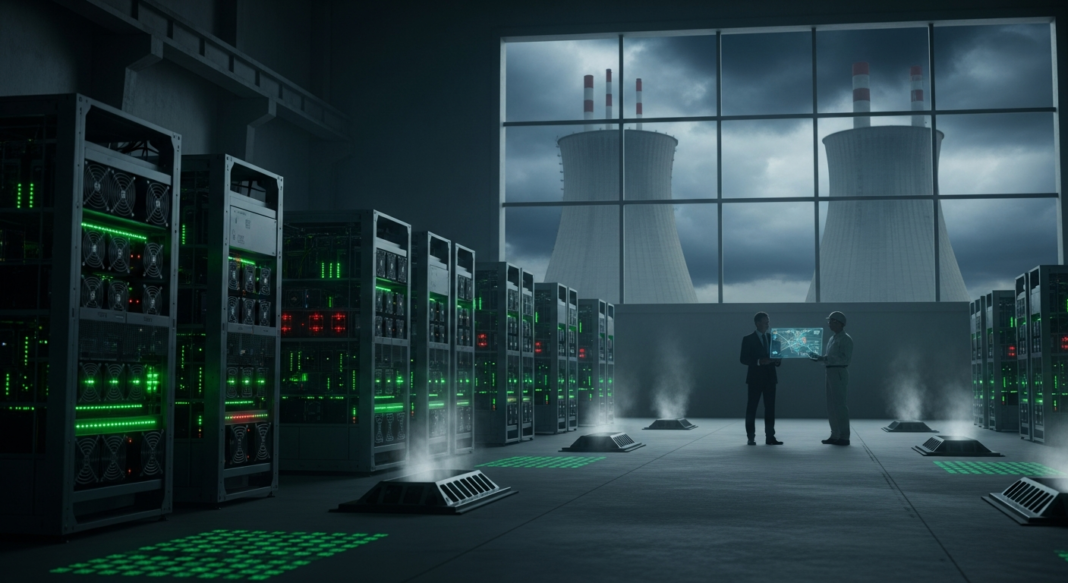
The Most Dangerous Trade in Crypto: Mining at the Edge of a Meltdown
I’ve lived through the 2017 ICO fever dreams and watched the 2022 FTX house of cards collapse into a pile of subpoenas, but the latest headline out of the Zaporizhzhia nuclear power plant (ZNPP) is a special kind of surreal. We aren’t talking about “green mining” with a few solar panels in Texas anymore. We are talking about plugging Bitcoin ASICs into a nuclear facility in the middle of a literal war zone, proposed as a “peace offering” between global superpowers.
Russian officials currently occupying the ZNPP recently signaled their readiness to let Bitcoin miners tap into the plant’s massive power output. The catch? It only happens if a peace deal is brokered. This isn’t just another headline about hash rate; it is a calculated geopolitical move that uses the Bitcoin network as a high-stakes bargaining chip in the ongoing conflict in Ukraine. For those of us who remember when the biggest risk in mining was a localized power outage or a sudden regulatory flip-flop in China, this is a grim reminder that crypto has moved from the fringes of the internet to the front lines of global warfare.
The \”American Proposal\” and the Diplomatic ASIC
According to reports from the Russian outlet Kommersant, Vladimir Putin recently informed business leaders that talks with the U.S. have drifted into some very strange territory. Specifically, Putin claimed that \”American colleagues\” suggested a joint-control arrangement for the ZNPP. Under this hypothetical plan, the plant’s output wouldn’t just keep the lights on for the local population; it would be used to power massive crypto-mining farms and supply electricity back to Ukraine.
The timing here is everything. This rhetoric comes on the heels of a two-hour summit in Florida between Donald Trump and Ukrainian President Volodymyr Zelenskyy. While the public statements focused on a revised peace plan, the backroom chatter seems to be exploring ways to monetize the contested Donbas region. If the U.S. and Russia actually end up co-managing a nuclear-powered Bitcoin mine in an occupied territory, we will have officially entered the most bizarre timeline in financial history.
Historically, we have seen states turn to mining when they are backed into a corner. Iran did it to bypass sanctions; Bhutan did it to leverage its hydro-resources; El Salvador did it for the “Volcano Bond” optics. But those were sovereign decisions. Zaporizhzhia is different. It is the largest nuclear plant in Europe, currently operated by Rosenergoatom (a subsidiary of Russia’s state-owned nuclear giant), and it’s sitting in a region that Russia claims but the world recognizes as Ukraine. Using Bitcoin as a neutral bridge to resolve a territorial dispute sounds like a cypherpunk’s fever dream, but the reality is likely much messier.
Baseload Power and the Nuclear Holy Grail
From a strictly technical perspective, nuclear power is the “Holy Grail” for Bitcoin mining. Miners crave “baseload” power—electricity that is consistent, 24/7, and doesn’t fluctuate like wind or solar. A nuclear reactor provides exactly that. For a facility like ZNPP, which has six reactors and a total capacity of nearly 6,000 megawatts, the sheer volume of hash rate it could support is staggering. We are talking about the potential to host a significant percentage of the global Bitcoin network in a single location.
However, the technical hurdles are immense. The plant has been damaged multiple times during the war. Just this past weekend, the UN’s International Atomic Energy Agency (IAEA) had to broker a local ceasefire just so technicians could repair damaged power lines. You cannot run a stable mining operation on a grid that is being shelled. Miners require cooling, stable voltage, and high-speed internet—none of which are guaranteed in a combat zone.
The IAEA’s involvement is a sobering reminder of the stakes. Their team is monitoring repairs not to help Bitcoiners secure the network, but to prevent a “Fukushima on the Dnipro.” Integrating a high-load industry like crypto mining into a fragile, repair-prone nuclear grid is an engineering nightmare that requires more than just a peace deal; it requires a complete overhaul of the regional infrastructure.
A Cynical Look at the \”Peace Deal\”
As a senior editor who has seen “game-changing” partnerships evaporate into thin air, I’m looking at this with a healthy dose of skepticism. Russia has historically been hot and cold on crypto. They like it for circumventing SWIFT and funding shadow imports, but they hate the loss of domestic monetary control. Framing ZNPP as a potential mining hub could simply be “maskirovka”—Russian military deception—designed to legitimize their occupation of the plant by inviting Western commercial interest.
If the U.S. were to engage in a joint mining venture at ZNPP, it would represent a radical departure from current policy. Let’s not forget that the U.S. Treasury’s OFAC has already sanctioned Russian mining companies like BitRiver. Participating in a project that directly enriches a Russian state-owned subsidiary like Rosenergoatom would require a massive legal U-turn and the unraveling of several layers of sanctions. It’s hard to imagine the current D.C. establishment—or even a new one—green-lighting a project that puts “American ASICs” under Russian military protection.
Risk Assessment: Shells, Sanctions, and Skepticism
For any trader looking at this as a “bullish” signal for Bitcoin adoption, take a breath. The risks here are asymmetrical.
- Physical Security: A peace deal on paper does not stop a rogue artillery shell or a sabotage mission. Any mining hardware deployed to ZNPP would be the highest-risk asset in the world.
- Sanction Contagion: Any BTC mined at ZNPP could potentially be flagged as “tainted” by exchange compliance desks if the coins are linked to sanctioned entities. We could see a two-tier Bitcoin market: “Clean” Western coins and “Atomic” Russian coins that trade at a discount.
- Political Volatility: This proposal is heavily dependent on the personal chemistry and shifting goals of Trump, Putin, and Zelenskyy. A single tweet or a failed negotiation could turn this “peace mine” back into a strategic target.
The bottom line? Bitcoin is being used as a diplomatic tool because it is the only asset that transcends borders and political systems. But using a nuclear flashpoint as a data center is the ultimate “degen” play. It’s one thing to bet on a token’s price action; it’s another to bet on a peace deal brokered with nuclear-powered hash rate. This isn’t financial advice, but if you’re looking for stability, you won’t find it at the Zaporizhzhia nuclear plant. This is the wild west of geopolitics, and the ASICs haven’t even been plugged in yet.