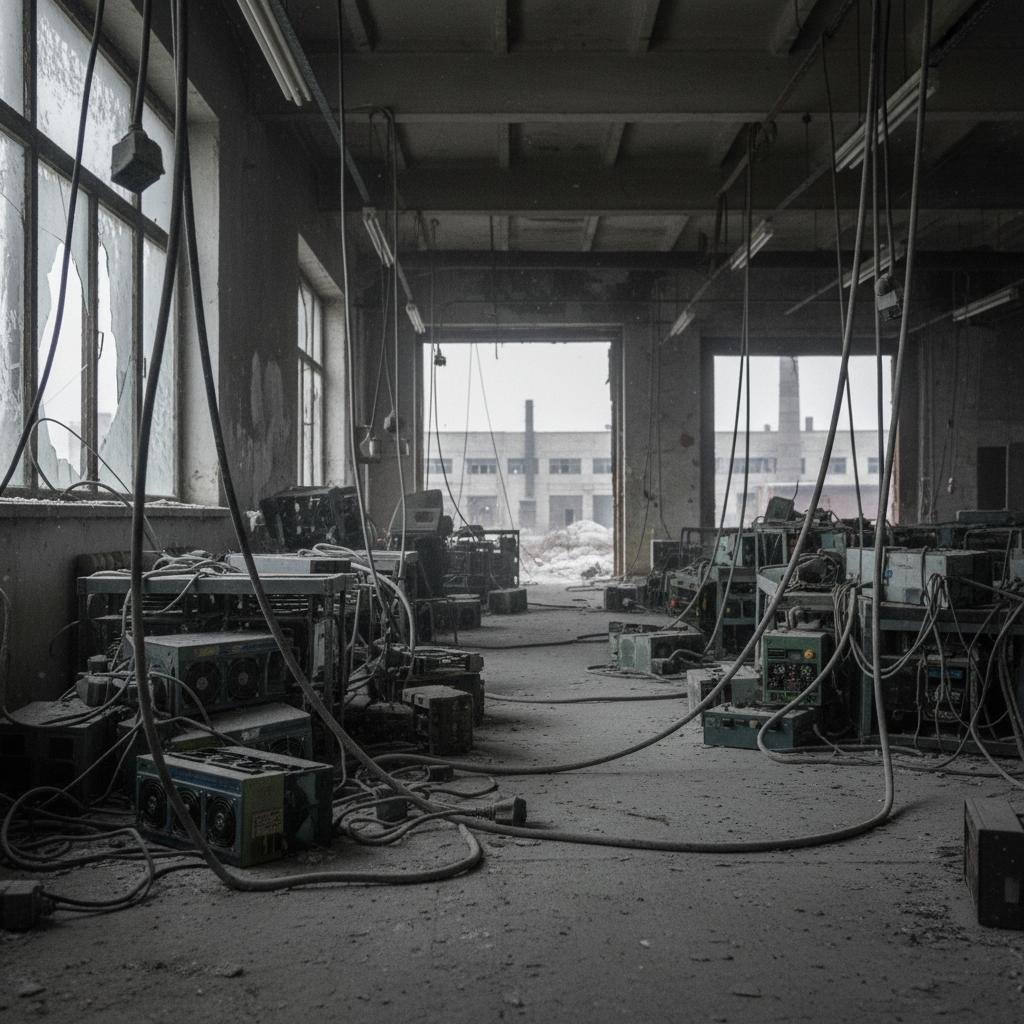
So Much for Russia’s Bitcoin Mining Dreams
Just when you thought Russia was serious about embracing crypto, a familiar old demon — power grid instability — has come back to haunt its Bitcoin mining ambitions. Forget Moscow’s grand talk of regulation and industrial growth. In key mining hotspots, local officials are practically cheering for year-round bans on crypto operations. It’s a classic case of conflicting signals, leaving miners in the lurch and investors scratching their heads.
A government commission is reportedly on the brink of enacting an indefinite ban on all crypto mining in Southern Buryatia and the entirety of Zabaykalsky Krai. This isn’t some minor tweak; this is a full-stop, indefinitely. And the local energy honchos? They couldn’t be happier.
“A complete ban on crypto mining is one of the measures that will help us stabilise the power supply,” a spokesperson for Buryatia’s Ministry for Transport, Energy, and Road Development openly declared. Let that sink in. A “complete ban” is seen as a solution, not a problem, for a region ostensibly trying to attract investment in a burgeoning industry.
The Power Problem That Won’t Quit
This isn’t a sudden blackout. For years, Russia has grappled with an aging and often overstressed power infrastructure, particularly in its eastern and southern regions. Bitcoin mining, with its insatiable thirst for electricity, simply exacerbated an already precarious situation. These aren’t just occasional flickers; these are systemic shortages.
Currently, southern Buryatia and Zabaykalsky Krai impose a winter ban on mining, running from November 15 to March 15. But come January 1, 2026, those temporary restrictions are set to become permanent. We’ve seen this play before. Moscow previously slapped similar indefinite bans on other hotspots, like the Irkutsk Oblast, extending them until 2031. It’s a trend, not an isolated incident.
The contradiction is glaring. Earlier this year, Moscow insisted no further mining bans were on the horizon. Yet, here we are. The reality on the ground – power grid issues plaguing Southern and Eastern Siberia, along with the North Caucasus – clearly overrides any central government rhetoric. The Buryatia ministry spokesperson laid it bare: power shortages across Irkutsk, Zabaykalsky Krai, and Buryatia itself have hit an astronomical 3,000 MW. That’s not a small gap; that’s a gaping wound in the power supply.
Why It Matters: A Blow to Russia’s Crypto Ambitions
For context, Russia once positioned itself as a major player in the post-China mining exodus. Its vast, cold expanses and seemingly cheap energy were supposed to be a magnet for miners seeking new homes. This latest crackdown fundamentally undermines that narrative. It’s a huge setback for a government that has, somewhat awkwardly, been trying to figure out how to regulate and benefit from the crypto industry. Deputy Energy Minister Yevgeny Grabchak, as recently as October, claimed no new bans were expected in 2025. Clearly, someone forgot to tell the power grid.
This isn’t just about turning off a few rigs. It’s about investor confidence, or the utter lack thereof. The Industrial Mining Association, representing some of the biggest players in the country, voiced its frustration to Kommersant, stating these new restrictions “reduce [Southern Siberia’s] attractiveness to investors.” No kidding. Imagine sinking millions into equipment and infrastructure, only to have the rug pulled out from under you by an arbitrary, indefinite ban. They rightly pointed out that it puts legally operating market players in a “vulnerable position.”
- **Sunk Costs:** Miners invest heavily in specialized hardware, facility setup, and cooling systems. A ban means these assets become stranded or must be expensively relocated.
- **Relocation Headaches:** Moving an industrial-scale mining operation isn’t like packing a suitcase. It involves complex logistics, customs, new site procurement, and re-establishment costs, all while facing downtime.
- **Abandoned Equipment:** Some miners aren’t even bothering to move. They’ve simply “abandoned their equipment” in areas like Irkutsk. That’s a direct loss of capital, a stark indicator of how untenable the situation has become.
- **Chilling Effect on Future Investment:** Why would any rational investor commit capital to a region where energy policy is so unpredictable and prone to sudden, indefinite shutdowns? The risk simply outweighs any perceived reward.
The “How”: Moscow’s Dilemma and Miner’s Plight
The process itself highlights Moscow’s balancing act. Regions must petition the central government for mining bans, with the final decision resting in the capital. While the Ministry of Energy claims it hasn’t received *other* requests for bans, the fact that these specific regions are pushing so hard, and Moscow is acceding, shows where the real pressure lies: at the local level, where power shortages are a daily reality for ordinary citizens, not just crypto entrepreneurs.
This is a testament to the fact that while a central government might have grand visions for a digital economy, practical infrastructure limitations can quickly override them. The need to maintain stable power for homes and essential services will always trump the demands of power-hungry, non-essential industries like Bitcoin mining.
For crypto traders and Web3 enthusiasts, this news offers a grim reminder of the operational risks inherent in centralized mining hubs. While the overall global Bitcoin hash rate is resilient and constantly adjusting, localized bans in a country once seen as a mining haven contribute to a more fragmented and potentially less efficient distribution of mining power. It underscores the critical importance of reliable, sustainable energy infrastructure – something many governments are still struggling to provide, even as they eye the potential economic benefits of crypto.
The takeaway? Don’t confuse political rhetoric with practical reality. Russia wants crypto, sure. But it wants stable power grids more. And until it can deliver both, its mining industry will continue to operate under a very unstable, very dim light.