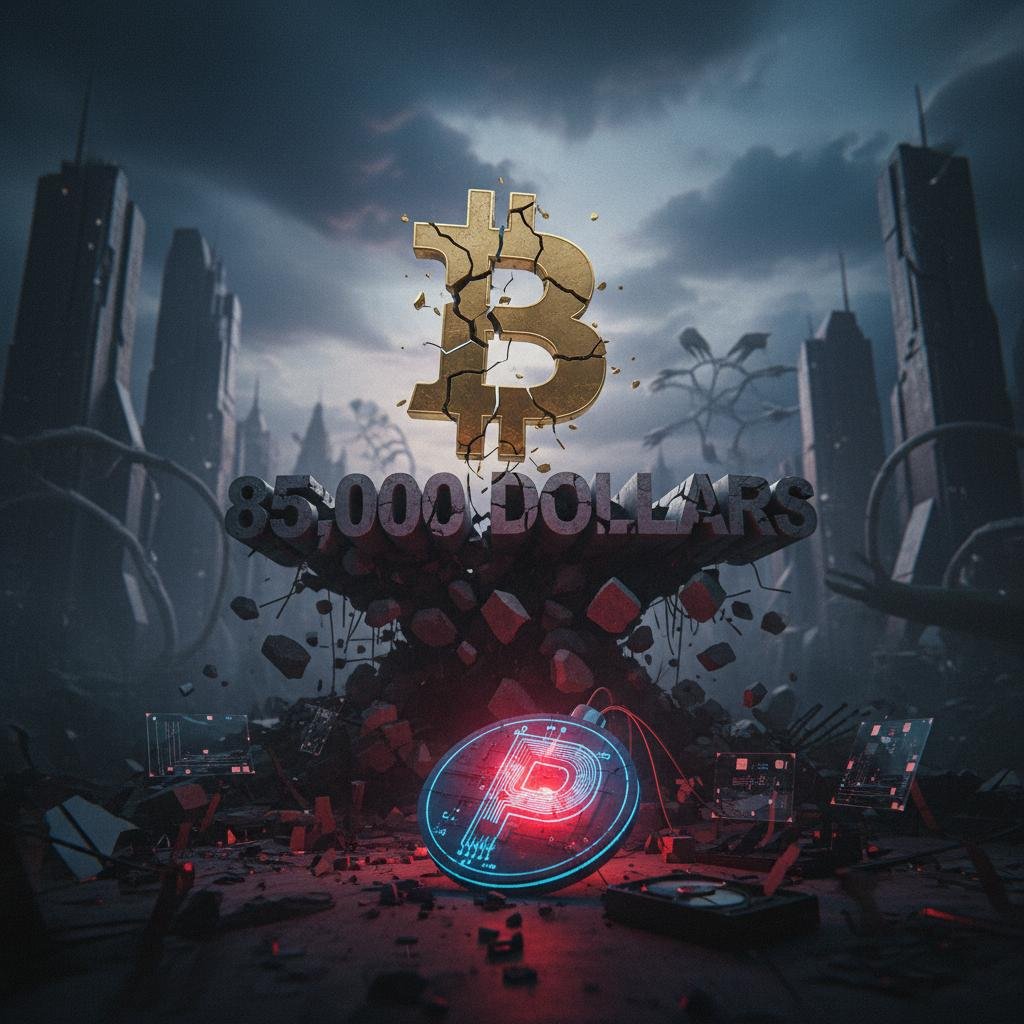
Bitcoin: The $85K Test and the Liquidation Games
Remember December 18? Bitcoin sure does. It was another one of those days where the market acted less like a steady train and more like a rodeo bull. BTC briefly flirted with $90,000, gave everyone a quick thrill, and then promptly dumped back to test that crucial $85,000 support level. What a ride.
For those tracking the charts, the $85,000 zone isn’t just a random number. Analysts are glued to it, and for good reason. We’re seeing steady ETF inflows – money actually flowing into the Bitcoin ecosystem – which helps prop up prices. On-chain data also whispers about less near-term sell pressure. In plain English? Fewer whales are dumping their bags, at least for now. This combination of institutional interest and holder confidence is what gives $85,000 its muscle.
But don’t let that fool you into thinking it was a calm day. Just a day prior, Bitcoin pulled off a chaotic two-hour stunt that saw it swing wildly. First, a blistering rally: $3,300 in 30 minutes, wiping out $106 million in short positions. That’s your classic short squeeze. Then, just as quickly, it reversed course, dumping $3,400 in the next 45 minutes, liquidating $52 million in longs. This wasn’t just volatility; it was a masterclass in market manipulation, leaving both bulls and bears bruised. Some market observers even point to a suspicious pattern around 10:00 a.m. EST, coinciding with U.S. stock market openings, where these abrupt, violent swings tend to appear. It highlights a market where algorithms and large players can wreak havoc, catching unsuspecting traders in the crossfire. It’s a stark reminder: even with “support,” nothing is guaranteed in crypto.
Altcoins: A Mixed Bag, With Some Red Flags
While Bitcoin played its games, the rest of the market showed similar jitters. Ethereum (ETH) felt the pain more acutely, sliding to around $2,844, a solid 2.85% daily drop and a whopping 10.77% loss on the week. Why the heavy sell-off? The usual suspect: large holders moving their ETH to exchanges. More supply on exchanges typically signals an intent to sell, and that added pressure quickly translated into lower prices. It’s a classic supply-and-demand dynamic playing out in real-time.
Solana (SOL) also joined the dip, trading near $123, down 3.31% for the day and 5.84% over seven days. Its movement largely mirrored the broader altcoin weakness. When Bitcoin struggles to find direction, altcoins often get hit harder, as traders de-risk and move capital out of speculative assets. There were a few bright spots, like BNB and XRP seeing modest gains, and stablecoins doing their job by sticking to their dollar peg. But overall, the global crypto market cap took a nearly 2% hit, reflecting the pervasive cautious sentiment.
PIPPIN: The AI Meme Coin “Ticking Time Bomb?”
Now, let’s talk about the real drama. While the big boys wrestled, a new contender emerged from the meme coin and AI segment: PIPPIN. This Solana-based project, combining meme culture with autonomous AI agents, actually recovered decisively after an initial dip. It now trades around $0.44 with a market cap north of $440 million. The story sounds good: an AI-generated unicorn evolving into a digital persona, supported by an open-source autonomous agent framework inspired by BabyAGI. Strong trading volumes and visible accumulation suggest some market participants are buying into both the narrative and the supposed tech. It sounds like the “next 100x crypto” everyone’s hunting for, right?
Not so fast. This is where the cynic in me—and reputable on-chain analysts—start yelling. Bubblemaps, a firm known for peering into token distribution, just flashed major red flags. Their analysis shows a concentrated cluster, likely insiders, controls a staggering 80% of PIPPIN’s supply. Previously, this was estimated at half. Now, that chunk is valued at around $380-$400 million. Eighty percent! Let that sink in. This isn’t decentralization; it’s a tightly held operation. Community posts on X, armed with Bubblemaps’ visualizations, are already calling PIPPIN a “ticking time bomb,” warning of manipulation risks and coordinated sells that could trigger devastating dumps. Why does this matter? If a few wallets hold most of the supply, they can easily manipulate the price, liquidate their holdings, and leave retail investors holding the bag. It’s a classic pump-and-dump setup, dressed up in AI and meme hype. Buyer beware, indeed.
Beyond the Hype: Security and Strategy
- ETF Flows Tell a Story: While Bitcoin ETFs saw positive daily inflows, the weekly total remained negative, hinting at mixed institutional sentiment. Ethereum ETFs bled out, with significant weekly outflows. Solana ETFs, however, continued to attract capital, showing sustained interest despite the broader market dip. This divergence in ETF performance offers a glimpse into where smart money is (and isn’t) flowing.
- The Multisig Hack Nightmare: In a chilling reminder of digital asset risks, a major crypto investor lost roughly $27.3 million due to a vulnerability in their multi-signature wallet. A leaked private key allowed the attacker to bypass protections, quickly funneling $12.6 million through Tornado Cash to obscure the trail. This isn’t just about careless individuals; it underscores that even advanced security setups like multisig can fail if a single point of vulnerability is exploited. In crypto, your security is only as strong as your weakest link.
- Bitcoin’s Quantum Leap?: Amidst all this, Michael Saylor, never one to shy from a bold statement, weighed in on quantum computing. He argues it won’t break Bitcoin but harden it. His theory: a future upgrade would enable active coins to migrate to quantum-resistant addresses, while lost coins stay permanently frozen. The result? Enhanced security and a reduced effective supply. It’s a futuristic take, but a reminder that Bitcoin’s architecture is constantly evolving, aiming to withstand future technological threats.
So, what’s the takeaway? The market remains a wild beast. Bitcoin hangs on by a thread, altcoins are finding their footing, and the hunt for that elusive “100x crypto” is pushing some into incredibly risky plays like PIPPIN. While innovation sparks excitement, the fundamentals of token distribution and security are often ignored at investors’ peril. As always, do your own research, question the hype, and never invest more than you can afford to lose. The next big thing might be out there, but so are plenty of ticking time bombs.