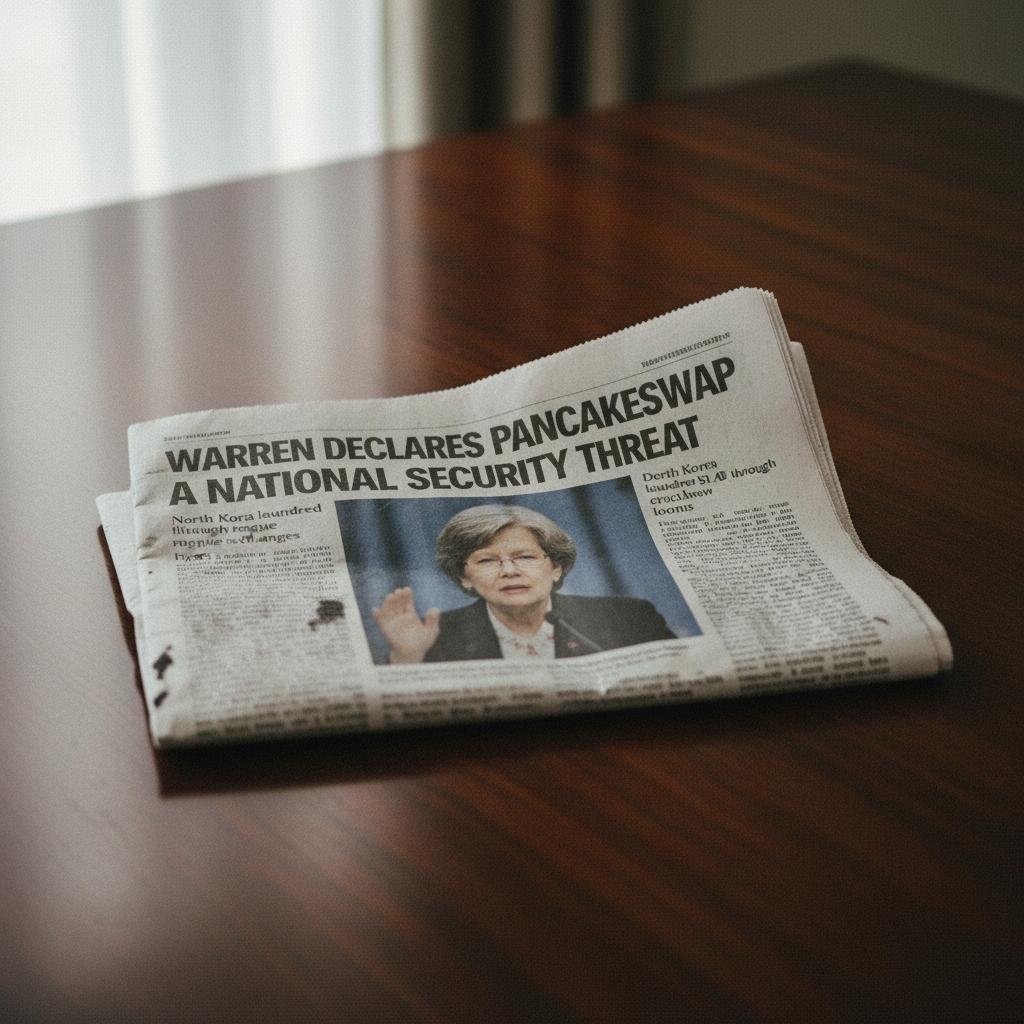
Warren Draws a Knife on PancakeSwap, Citing National Security
Senator Elizabeth Warren isn’t just taking aim at crypto anymore; she’s got a laser lock on PancakeSwap, calling it a national security risk. Yeah, the same PancakeSwap you probably used last week. This isn’t just another broadside; it’s a direct hit, and it brings a political circus with it, all centered around the gaping hole Warren sees in decentralized finance (DeFi).
Remember when Warren famously waged war on sandwich mergers? While people struggled with Bidenflation, she was out there, fighting the good fight against “Big Sandwich.” Now, she’s swapped ciabattas for crypto, escalating her long-running feud with the industry, this time with a sharp focus on decentralized exchanges (DEXs).
In a pointed letter this week, addressed to Treasury Secretary Scott Bessent and Attorney General Pam Bondi, the Massachusetts senator laid down a January 12 deadline. She wants answers: are US regulators adequately policing DeFi platforms? Especially those operating far outside the traditional, government-mandated anti-money laundering (AML) frameworks? It’s not an abstract concern for her; she’s got receipts, and PancakeSwap is front and center.
The $1.4 Billion Question: North Korea, Hacks, and KYC-Free Zones
Warren isn’t just grandstanding. She’s pointing directly to PancakeSwap’s alleged role in laundering funds tied to North Korea’s largest-ever crypto heist. That’s not pocket change; it’s a staggering $1.4 billion. And if that wasn’t enough, she also highlighted PancakeSwap’s more recent embrace of USD1, a dollar-backed stablecoin linked to Donald Trump-backed World Liberty Financial. Suddenly, the ‘DeFi Wild West’ narrative feels a lot less romantic and a lot more dangerous.
Here’s the kicker: Warren’s letter heavily leans on hard data from blockchain forensics. Analytics firm Allium and investigations specialist TRM Labs traced roughly $263 million—a cool 20% of the $1.4 billion pilfered from Bybit in February—right through PancakeSwap liquidity pools. That’s a quarter-billion dollars, vanished into the decentralized ether, allegedly facilitated by a platform designed to be permissionless.
Warren minced no words. She wrote: “Without regulatory monitoring, illicit actors will increasingly be able to acquire crypto assets on decentralized exchanges and facilitate transactions without institutions that could otherwise flag suspicious activity.”
This statement encapsulates the core of her argument. DEXs, by design, process billions in daily trading volume without the standard Know Your Customer (KYC) checks that traditional financial institutions, and even centralized crypto exchanges, are forced to implement. What the crypto faithful champion as a philosophical feature – permissionless, anonymous access – Warren, and a growing chorus of regulators, are now framing as a glaring national security vulnerability. It’s a battle between financial freedom and national security, and the lines are getting blurrier by the minute.
Trump, Stablecoins, and the Politics of Enforcement: A Combustible Mix
This isn’t just about illicit funds; it’s also about politics, and potential corruption. According to DeFi Llama, PancakeSwap consistently clears billions in monthly trading volume across BNB Chain and Ethereum-linked networks. CoinGecko data confirms its status as one of the top DEXs globally by users and liquidity. Meanwhile, Glassnode data from 2025 indicated a surge in illicit on-chain flows during major hacks. Why? Because as centralized exchange monitoring tightened, bad actors simply migrated to DeFi rails. It’s a cat-and-mouse game, and Warren thinks the cat is losing.
This shift matters, especially as Congress continues to debate crypto market structure. But there’s an added layer of political intrigue that makes this particular fight combustible: the Trump connection. Earlier this year, PancakeSwap partnered with World Liberty Financial to promote USD1 trading. This happened just months after Binance deepened its own integration of the same Trump-linked stablecoin. Binance, for its part, denied any connection between this expansion and Changpeng Zhao’s pardon, but Warren remains unconvinced.
She fired another warning shot: “It is critical to understand whether enforcement decisions are being influenced by political connections.” In a highly charged political climate, the specter of “political connections” influencing financial enforcement decisions is a red flag that will draw fire from all sides.
Why This Fight Matters for Your Crypto Portfolio in 2026
Markets, whether energy, equities, or crypto, are repricing around political risk once again. This isn’t some distant, theoretical debate. This is a direct threat to the operational model of a significant chunk of the DeFi ecosystem. If DeFi becomes the sacrificial lamb in the legislative process – an easy target to get a broader crypto bill passed – the impact could be swift and brutal. Liquidity, notoriously flighty in crypto, could migrate fast, leaving a wake of volatility and uncertainty.
Conversely, if regulators don’t move, Warren has clearly signaled she will keep dragging platforms like PancakeSwap into the spotlight, applying relentless pressure. Either way, the message is clear: the era of DeFi flying under the radar is officially over. What we’re witnessing now is one of the final, defining battles for the future of decentralized finance. Keep your eyes peeled, and your portfolios hedged; this fight is just getting started.