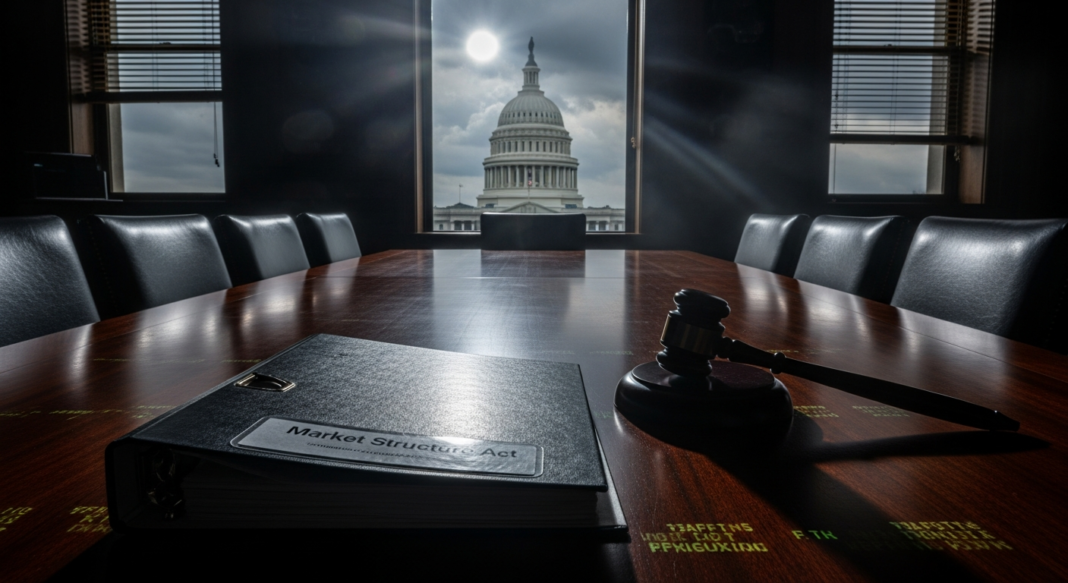
The 2025 Hangover: Why the ‘Clarity Act’ is Ghosting the Crypto Industry
2025 was supposed to be the year the crypto industry finally grew up. We got the pro-crypto President, the stablecoin legislation that everyone pretended to understand, and a Bitcoin price that made the 2017 bull run look like a rounding error. But as we stare down the barrel of 2026, the industry’s biggest wish—a definitive market structure bill—is stuck in a legislative quagmire that should look hauntingly familiar to anyone who watched the 2022 FTX collapse lead to two years of “regulation by enforcement.”
The “Clarity Act,” the piece of legislation designed to finally draw a line in the sand between what is a security and what is a commodity, has slowed to a crawl. While the industry is busy celebrating its “deregulatory blitz” at the SEC under Paul Atkins, some heavy hitters are sounding the alarm. If this bill doesn’t cross the finish line by the first half of 2026, the political window might slam shut for years.
“The optimal time for the Clarity Act to pass has already passed,” Matt O’Connor, founder of Legion, told DL News. It’s a cynical take, but in this industry, cynicism is usually just realism with a different font. We’ve spent years begging for rules of the road. Now that the road is being paved, the construction crew has decided to take a very long lunch break.
The Jurisdictional Tug-of-War: SEC vs. CFTC
To understand why the Clarity Act is stalled, you have to look at the technical guts of how US financial regulation works. This isn’t just about “crypto being legal”; it’s about which three-letter agency gets to collect the fees and wield the gavel. The core conflict remains the same one we’ve seen since the ICO boom: the divide between the Securities and Exchange Commission (SEC) and the Commodity Futures Trading Commission (CFTC).
- The SEC Case: Historically, the SEC has viewed almost every token with a heartbeat as an investment contract under the Howey Test. This requires massive disclosure and compliance costs that most decentralized projects simply can’t meet.
- The CFTC Case: The industry wants the CFTC to take the lead. The CFTC is generally seen as more “principles-based” and less likely to sue a developer for writing code. The Clarity Act aims to give the CFTC more power over “digital commodities,” but defining where a “security” ends and a “commodity” begins is proving to be a legislative nightmare.
- The Decentralization Threshold: The bill attempts to create a metric for when a project is “sufficiently decentralized” to move from SEC oversight to CFTC oversight. But as any DeFi developer will tell you, decentralization is a spectrum, not a toggle switch.
This isn’t just academic. For institutional players—the BlackRocks and Fidelitys of the world—the lack of a federal market structure bill is a massive yellow light. They want the “checkered flag” of a signed law, not just a friendly Chairman at the SEC who might be gone in four years.
DeFi and the Bank Secrecy Act: The Real Sticking Point
If you want to know what’s actually gumming up the works, look at Decentralized Finance (DeFi). The technical hang-up isn’t just about token classification; it’s about the Bank Secrecy Act (BSA). Lawmakers are currently locked in a standoff over how to handle the “front-ends”—the websites you use to access protocols like Uniswap or Aave.
One side of the aisle wants to treat these front-ends as brokers or exchanges, forcing them to implement strict Anti-Money Laundering (AML) and Know Your Customer (KYC) protocols. The other side argues that these are just interfaces for autonomous code and shouldn’t be burdened with the same regulations as a bank in Nebraska. Bill Hughes, director of global regulatory matters at Consensys, pointed out that this disagreement is the “most important hangup” to the entire bill. Without a compromise on DeFi, the bill is effectively dead on arrival.
The Paul Atkins Factor: A Deregulatory Band-Aid?
While Congress fumbles the ball, SEC Chairman Paul Atkins is running a different play. His “Project Crypto” is a deregulatory blitz aimed at undoing the “shakedown” era of his predecessor. Atkins has been vocal about his belief that most tokens are not securities, which has provided immediate relief to the markets. O’Connor notes that this shift in SEC tone will have a much bigger impact on the “everyday user experience” than some of the more hyped-up legislative wins.
But here’s the rub: SEC guidance is not law. It’s an administrative stance. If the political winds shift in the 2026 midterms or the 2028 general election, a new Chairman could easily pivot back to the “enforcement first” strategy. This is why the industry is so desperate for the Clarity Act. We don’t just need a friendly regulator; we need a permanent statute that survives the next administration.
The Global Ripple Effect and the 2026 Midterm Cliff
The US doesn’t exist in a vacuum. While Washington bickers, Europe has already deployed MiCA (Markets in Crypto-Assets), and the UK is eyeing a 2027 rollout for its own framework. However, as Benoit Merzouk of BCP Technologies put it, “It’s impossible to go against the tsunami.” The US is that tsunami. When the US stalls, it creates a vacuum of liquidity and innovation that even the most progressive European rules can’t fully fill.
The clock is ticking because of the 2026 midterms. If Republicans lose control of either chamber of Congress, the odds of a comprehensive market structure bill passing drop to near zero. We’ve seen this pattern before—gridlock is the natural state of DC, and crypto is often the first casualty of partisan bickering. Bill Hughes suggests that if the midterms don’t go the GOP’s way, we might be waiting until 2027 or later for any real legislative movement.
Risk Assessment: Don’t Mistake a Reprieve for a Resolution
For traders and enthusiasts, the current “deregulatory blitz” feels like a win, and in the short term, it is. But there are significant risks to consider:
- Legislative Ghosting: If the Clarity Act fails, the industry remains at the mercy of the “Atkins SEC,” which can be overturned by a single presidential election.
- The DeFi Crackdown: Even if tokens are deemed commodities, the front-ends of DeFi protocols remain in a legal gray area regarding the Bank Secrecy Act. “True decentralization” remains a high bar that many popular protocols may not actually meet under legal scrutiny.
- Institutional Withdrawal: While retail is hyped, big banks are cautious. They have “long-standing risk controls,” as Fireblocks’ Dea Markova noted. If the US fails to provide a federal law, we might see the much-prophesied “institutional wave” remain a ripple.
The bottom line? 2025 gave the industry a seat at the table, but 2026 is where we find out if we’re actually on the menu. This isn’t financial advice—it’s a warning. In crypto, the only thing more dangerous than a hostile regulator is the false sense of security provided by a temporary one.