The Day the Flow Stopped: A $3.9 Million Wake-Up Call
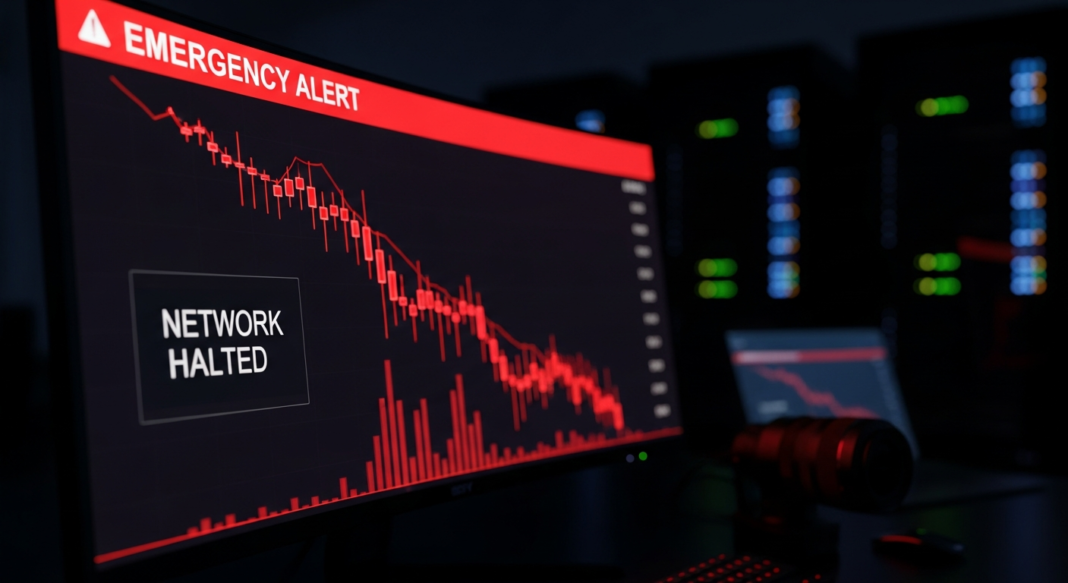
If you were holding FLOW tokens on December 27, 2025, you didn’t need a morning coffee to wake up. The 42% cratering of the token price—plummeting from $0.17 to a gut-wrenching $0.079 in a matter of hours—told the story before the official tweets even hit the timeline. While the broader market was coasting, Flow was fighting for its life as an attacker poked a hole in the network’s execution layer, siphoning off roughly $3.9 million in assets.
For those of us who lived through the 2022 bridge exploit era or the constant “Solana is down” memes of years past, this felt hauntingly familiar. But as the dust begins to settle and the Flow Foundation moves into its “read-only” recovery phase, the narrative is shifting from a generic crypto heist to a surgical technical failure. This wasn’t a “North Korea-style” wallet drain or a social engineering scam targeting users. It was a failure of the machine itself—the execution layer.
The Flow Foundation was quick to hit the kill switch, coordinating a network halt that effectively froze the blockchain in its tracks. It’s the “break glass in case of emergency” move that every decentralized purist hates, but every pragmatic investor appreciates when millions are on the line. As of now, the network is a ghost town, awaiting a protocol-level patch and a synchronized restart that reminds us just how centralized “decentralized” recovery actually is.
Execution vs. Custody: Why Your Wallet Isn’t Empty
To understand why this exploit didn’t result in every NBA Top Shot owner losing their Dapper balance, we have to look at the plumbing. In blockchain architecture, the execution layer is the engine room where transactions are processed and the state of the network is updated. The attacker found a vulnerability within this specific mechanism—think of it as finding a way to mint “phantom” value or redirecting the network’s own internal accounting rather than cracking the private keys of individual users.
The Foundation has been adamant: user funds are safe. This is a critical distinction. In the 2022 FTX collapse, the custody itself was the fraud. In the Ronin Bridge hack, the keys were the target. Here, the “execution mechanics” were the victim. The attacker managed to move $3.9 million off-network, but those funds essentially came from the network’s own liquidity or protocol-level reserves rather than being “stolen” from your personal wallet. It’s the difference between a bank robber blowing the vault door (custody) and a white-collar criminal finding a glitch in the wire transfer software to send themselves money (execution).
However, “safe funds” are cold comfort when the token price collapses. The 42% drawdown shows that the market doesn’t care about the nuance of the exploit during the first hour of panic. When a network goes dark, liquidity providers pull their stakes, risk desks sell first and ask questions later, and the “uncertainty premium” begins to eat the valuation alive. FLOW has since clawed back to the $0.12 range, but the scar tissue remains.
The Great Laundromat: How the Funds Disappeared
Once the attacker secured the $3.9 million, they didn’t sit around waiting for a pat on the back. They followed the modern exploiter’s manual for “How to Exit a Halted Chain.” The funds were routed through a gauntlet of cross-chain bridges: Celer, deBridge, Relay, and Stargate. This is the “hop-and-wash” strategy that makes on-chain forensics a nightmare.
By jumping across multiple bridges, the attacker obscures the direct lineage of the tokens. From there, the trail leads into the usual suspects of the decentralized “laundromat”: THORChain and Chainflip. These protocols allow for cross-chain swaps without a centralized intermediary, making it incredibly difficult for the Flow Foundation to simply “call a CEO” and freeze the assets. While Circle and Tether have been notified to potentially blacklist any stablecoins involved, the reality of the 2025 crypto landscape is that once funds hit a cross-chain liquidity pool, they are often as good as gone.
- Primary Exit Routes: Celer, deBridge, Relay, Stargate.
- Obfuscation Layers: THORChain, Chainflip.
- Current Status: Assets identified and flagged, but likely fragmented across multiple chains.
The Choreography of the Restart
You can’t just “turn a blockchain back on” like a router. The Flow Foundation is currently engaged in what they call “extended coordination and synchronization.” Because Flow is integrated with a massive ecosystem of indexers, exchanges (like Binance and Coinbase), and infrastructure providers, a fragmented restart would be a disaster. If one exchange thinks the network is at Block A and another thinks it’s at Block B, you get “state mismatches” that can lead to double-spending or lost deposits.
The Foundation has provided specific reference points for the restart:
- Flow Cadence Height: 137,363,395
- Flow EVM Height: 51,358,233
Every major validator and partner has to roll back or sync to these specific heights. It’s a painstaking process that prioritizes “data integrity over speed.” The Foundation is aiming for a 4-to-6-hour window for the restart, but in the world of crypto remediation, “pending validation” usually means “expect delays.” The network remains in read-only mode, meaning you can look at your assets, but you can’t move them. It’s a digital museum of your own money until the Mainnet 28 patch is fully verified.
Risk Assessment: The Long Road to Recovery
Is Flow “dead”? Hardly. A $3.9 million exploit is a rounding error compared to the $600 million Poly Network hack or the $625 million Ronin event. The Foundation’s transparency—posting updates every two hours—is a gold standard in an industry known for radio silence during crises. However, the trust deficit created by a network halt cannot be ignored.
The real risk here isn’t the $3.9 million lost; it’s the “L1 Reliability” narrative. For a chain that markets itself as the premier home for consumer-grade NFTs and gaming, “we had to shut down for a day because of an execution bug” is a tough sell to big-brand partners like the NBA or Disney. These entities value uptime above almost everything else. If the “Disney of blockchains” has a blackout, the skeptics in boardrooms get louder.
Investors should watch the 72-hour technical post-mortem closely. We need to know if this was a “one-off” oversight or a systemic flaw in how Cadence (Flow’s programming language) handles execution state. If it’s the latter, this might not be the last time the network goes into read-only mode. For now, the “buy the dip” crowd is battling the “get me out” crowd, and the victor will be decided by how smoothly the ingestion resumes tomorrow morning.
Disclaimer: This analysis is for informational purposes and does not constitute financial advice. The crypto market is highly volatile, and protocol exploits carry significant risks to capital.