The $12.50 Invisible Wall: Why Your Bank Isn’t Buying XRP (Yet)
For the better part of a decade, the XRP community has lived on a diet of “bank adoption” hopium. We’ve seen the pilot programs, the slick RippleNet brochures, and the endless “partnership” announcements that often turned out to be little more than a glorified trial of a messaging system. But despite XRP being built specifically for cross-border liquidity, the one thing we haven’t seen is banks actually holding the damn thing on their balance sheets. It’s the ultimate crypto paradox: an asset designed for banks that banks are effectively forbidden from owning.
If you listen to the “Moonboys” on X, they’ll tell you it’s a conspiracy by the SEC or a secret plan by the IMF. The reality is much more boring and much more expensive. It’s a math problem called Basel III, and until recently, the math made holding XRP a suicidal move for any regulated financial institution. But the gears of global bureaucracy are finally grinding, and a subtle shift in risk weighting might do more for XRP’s price than any court ruling ever could.
The Basel III Trap: A 1,250% Weighting Nightmare
To understand why banks have stayed on the sidelines, you have to understand how they are regulated. Following the 2008 financial crisis—an era many of us remember as the catalyst for Bitcoin’s birth—global regulators realized that banks were playing too fast and loose with their reserves. They created the Basel III framework, a set of international standards designed to ensure banks have enough “High-Quality Liquid Assets” (HQLA) to survive a market crash.
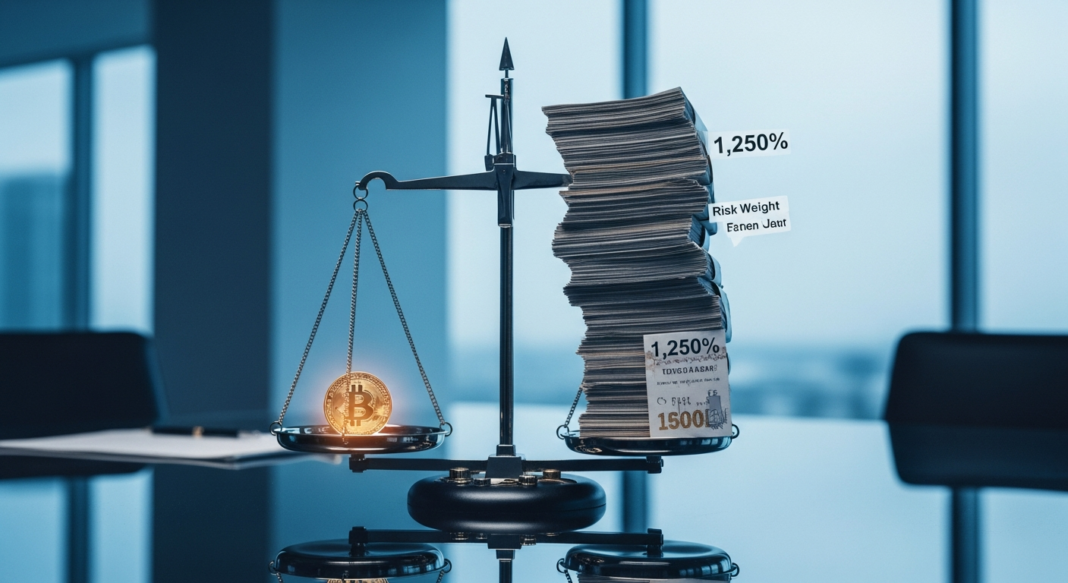
Under these rules, every asset a bank holds is assigned a “risk weight.” If a bank holds cash or government bonds, the risk weight is low. If they hold something volatile, the risk weight is high. Currently, the Bank for International Settlements (BIS) classifies XRP as a “Type 2” crypto exposure. This is the regulatory equivalent of the “danger” zone. Under Type 2 rules, XRP carries a 1,250% risk weight.
Let’s do the math that keeps bank CFOs up at night. A 1,250% risk weight means that for every $1 worth of XRP a bank wants to hold, they must set aside $12.50 in capital reserves to cover the potential loss. Think about that. If a bank wanted to hold $100 million in XRP to facilitate a liquidity corridor between New York and London, they would have to lock up $1.25 billion in capital. No bank executive in their right mind would ever sign off on that. It is capital inefficiency at its finest, turning a high-velocity asset into a lead weight on the balance sheet.
Beyond the SEC: The True Inflection Point
Market commentator Stern Drew recently highlighted on social media that this capital barrier is the real reason for institutional hesitation. While the crypto world was obsessed with Judge Analisa Torres and the “is it a security?” debate, the banking world was looking at the Basel Committee’s spreadsheets. The tech worked, the demand was there, but the regulatory price tag was simply too high.
The “inflection point” we’re seeing now isn’t just about Ripple’s legal wins; it’s about the potential reclassification of XRP within this global framework. As regulatory clarity improves—and as XRP cements its status as a non-security in the U.S. markets—the path clears for it to be moved from a Type 2 “high-risk” asset to a lower-risk category, potentially alongside tokenized traditional assets or stablecoins with robust backing.
If XRP is reclassified, the 1,250% risk weight disappears. It would be replaced by a much more manageable requirement, allowing banks to actually custody the asset. This shifts the entire XRP narrative from “off-balance-sheet utility” (where banks just use Ripple’s software) to “direct institutional ownership” (where banks own the underlying asset to provide their own liquidity). In the world of finance, ownership is the only thing that creates true, deep-market liquidity.
The Shift from Bridge to Reserve
For years, Ripple’s primary product was ODL (On-Demand Liquidity), now known as Ripple Payments. The genius of ODL was that it allowed banks to use XRP for settlement without actually holding it. They would buy XRP in one fiat currency, send it, and sell it for another fiat currency in seconds. This bypassed the Basel III problem because the bank didn’t “hold” the asset long enough for it to hit the balance sheet in a meaningful way.
But ODL has its limits. It relies on third-party liquidity providers and exchanges to have the depth to handle large transfers. If banks can hold XRP directly—without the 1,250% penalty—they become the liquidity providers. This is the difference between renting a bridge and owning the highway. We’re talking about moving from a system of “just-in-time” liquidity to a world where XRP functions as a Tier-1 digital reserve asset for international settlements.
Risk Assessment: Don’t Pop the Champagne Yet
As a veteran of the 2017 “everything is a partnership” era, I have to inject a dose of skepticism here. While the path to reclassification is clear, the timeline is anything but. Global banking regulators move at the speed of an iceberg. Even if the logic for reclassification is sound, the political appetite for “helping” crypto is still low in many jurisdictions.
- Bureaucratic Inertia: Basel III revisions and classifications are not updated overnight. We are likely looking at a multi-year rollout for these changes to take full effect globally.
- The “Stablecoin” Competitor: Banks might prefer to hold tokenized versions of the US Dollar (stablecoins) rather than a volatile asset like XRP, even if the capital requirements are the same.
- Regional Fragmentation: Just because the BIS sets a standard doesn’t mean every country follows it the same way. The U.S. Federal Reserve, the ECB, and the BoJ all have their own ways of interpreting these rules.
The bottom line? The 1,250% risk weight has been a “No Entry” sign for banks since XRP’s inception. Removing that sign is the most significant fundamental catalyst in the history of the token, but don’t expect the floodgates to open tomorrow. This is a game of plumbing, not just price action. And as any plumber will tell you, clearing a massive clog takes time and the right tools. XRP just finally found the wrench.
Disclaimer: This analysis does not constitute financial advice. The author has lived through enough liquidations to know that “regulatory clarity” is often a double-edged sword. Trade with your head, not your heart.