The Reckoning: Fifteen Years for Terra’s Architect
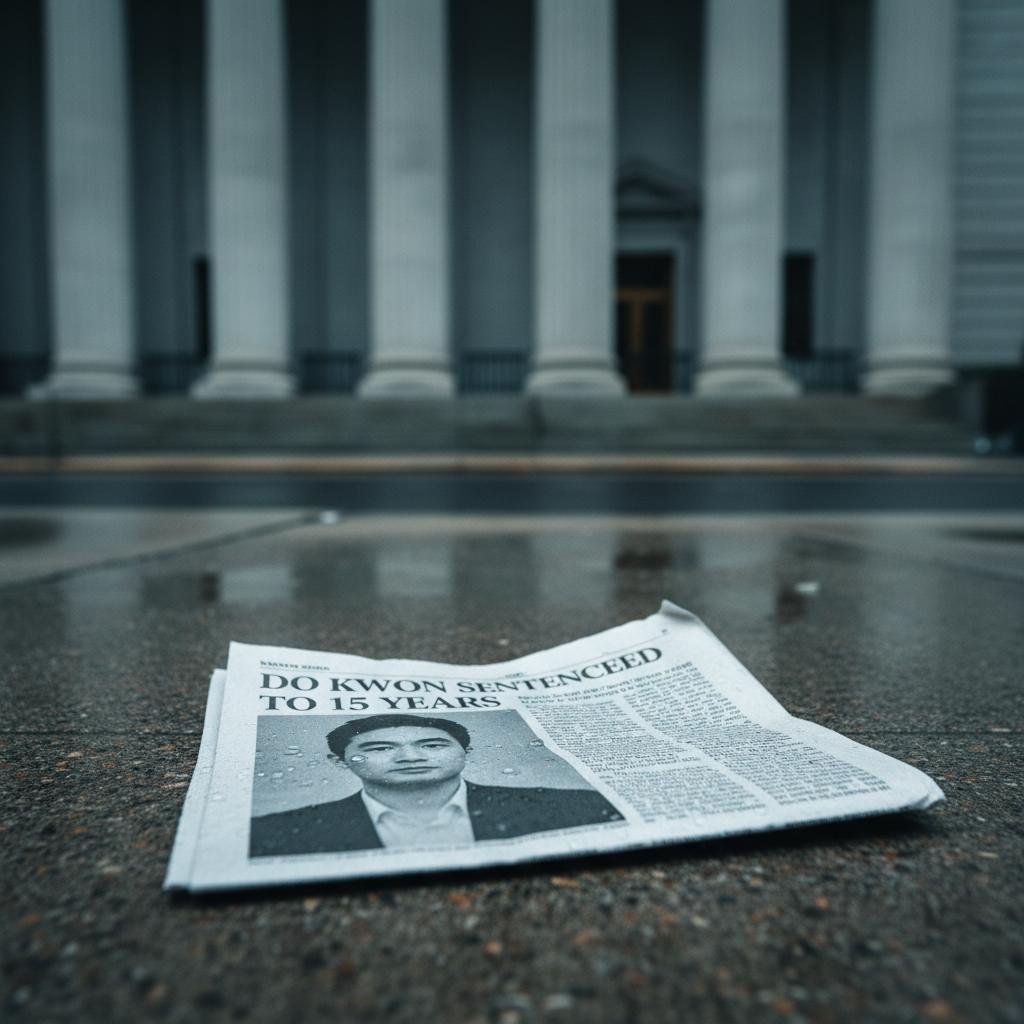
In a New York City courtroom, the gavel came down hard on Do Kwon, the once-celebrated co-founder of Terraform Labs. Federal Judge Paul Engelmayer slapped him with a 15-year prison sentence, calling the Terra implosion a “fraud on an epic, generational scale.” It’s a stark, brutal end to a saga that evaporated an estimated $40 billion for investors and sent shockwaves through the entire crypto market. No more “Don’t debate the poor.” The judge ensured Kwon would feel the sting of poverty – behind bars.
Kwon’s defense attorney, David Patton, painted a picture of a man who’d experienced “an extraordinary rise and fall.” He pleaded for mercy, citing Kwon’s guilty plea and an impending, potentially longer, sentence back in South Korea. Patton even argued Kwon was “no thief,” merely someone who “misled investors.” Engelmayer wasn’t buying it. He saw a man who consciously chose the “path of fraud,” creating a “graphic reminder” for any future crypto hucksters thinking they can fleece the public and walk away clean.
The judge had ample reason for his harsh judgment. Victims recounted harrowing tales: a woman, Tatiana Dontsova, sold her Moscow home, invested $81,000 in UST, and ended up homeless in Tbilisi. Chauncey St. John, who built a non-profit, lost millions, including his in-laws’ retirement savings. Some victims even contemplated suicide. These aren’t abstract numbers; these are lives shattered. As Engelmayer put it, “Those are hard facts. They demand a very long sentence.”
The Algorithmic Lie: How Terra Was Designed to Fail
To understand the depth of Kwon’s deception, you have to rewind to Terra’s origins. Kwon, a Stanford grad who shunned Microsoft for the siren call of entrepreneurship, launched Terraform Labs in 2018 with Daniel Shin. Their big play was Terra, a blockchain, and UST, a stablecoin supposedly pegged to the US dollar. Initially, Kwon pitched it as partly fiat-backed. But by its September 2020 launch, that vision had morphed into something far more precarious: an algorithmic stablecoin.
UST wasn’t backed by actual dollars. Instead, it maintained its $1 peg through a complicated arbitrage mechanism with Terra’s governance token, LUNA. The idea was simple enough: if UST dipped below $1, users could swap one UST for $1 worth of LUNA, theoretically creating demand for UST. If UST went above $1, the reverse happened. Kwon, the self-proclaimed genius, even acknowledged the possibility of a “death spiral” in the very document detailing this design. It’s almost unbelievable in hindsight.
For traders and investors, the allure was simple: high yields. Terra’s DeFi ecosystem grew to be the second largest, trailing only Ethereum. UST became the third-largest stablecoin. It felt like an innovation, a true Web3 solution to stability. But beneath the surface, the foundation was crumbling, held together by PR, bluster, and ultimately, lies.
The Cracks Show: May 2021 and the Deceptive Cover-Up
That “death spiral” wasn’t some theoretical future event. It happened. On May 23, 2021, UST dipped to $0.92. LUNA also plunged, casting serious doubt on the entire peg-stability mechanism. The system was failing. Instead of admitting failure, Kwon, desperate, turned to Kanav Kariya, head of Jump Crypto. Jump shelled out over $20 million to prop up UST, getting a sweet deal on LUNA in return. The peg recovered. Investors breathed a sigh of relief. And Kwon?
He lied. Publicly, he attributed UST’s recovery to the elegance of its design, mocking skeptics like economist Frances Coppola with his infamous “I don’t debate the poor on Twitter” barb. But privately, he spilled the beans to Terraform’s head of public relations: “If [Jump] had not stepped in, we might have been fucked.” That admission, buried in court documents, is a damning indictment of his public persona. He actively misled investors, making them “unwitting participants” in what he knew was an unstable experiment.
This cover-up was the critical turning point. It wasn’t just an “experiment gone wrong”; it was a deliberate act of deception. For traders, this highlights the absolute necessity of rigorous due diligence, scrutinizing whitepapers, and not blindly trusting charismatic founders. When a system relies solely on an algorithm, the underlying assumptions are everything. And when those assumptions fail, and the founder lies about it, disaster is inevitable.
A Web of Deceit: Luna Foundation Guard, Mirror, and Chai
Kwon didn’t stop at covering up the May 2021 depeg. He built an intricate web of falsehoods. In January 2022, he raised about $3 billion for the Luna Foundation Guard (LFG), a supposedly independent entity tasked with defending UST’s peg. Prosecutors alleged almost everything he said about LFG was a lie. Kwon maintained full control, and when UST famously broke its peg again in May 2022, he diverted hundreds of millions to Terraform Labs for expenses, rather than use it to defend the peg. LFG was merely another tool in his arsenal of deception.
Then there was Mirror Protocol, pitched as a decentralized platform for synthetic assets. Kwon publicly claimed he had minimal control, but in reality, he wielded substantial power over the cooperative running it. And Chai, a South Korean payment processor, was another fraud. Kwon insisted Chai used the Terra blockchain for transactions, creating revenue for LUNA stakers. This was a crucial part of the LUNA value proposition, essential for maintaining the UST peg. In truth, Chai used traditional banks. Kwon simply spoofed the transactions on Terra, using Terraform’s own stablecoins to pay LUNA stakers the yield they believed came from Chai. It was an elaborate stage play, designed to create the illusion of utility and value.
This level of systemic manipulation is a cold reminder to the Web3 community: “decentralized” doesn’t automatically mean transparent or honest. The centralized control and fraudulent activities within ostensibly decentralized projects underline the inherent risks of founder influence and the need for genuine, verifiable decentralization.
The Final Collapse: “$40 Billion Vaporized”
The house of cards finally collapsed in May 2022. UST again fell below a dollar, this time irrevocably. Kwon, with his characteristic bravado, tweeted, “Deploying more capital — steady lads,” in a desperate attempt to reassure investors. It was futile. Within days, UST and LUNA were virtually worthless. The entire $40 billion ecosystem was vaporized.
The impact was catastrophic, extending far beyond Terra itself. Crypto prices plummeted across the board. Major players like crypto lender Celsius and exchange FTX — businesses that also turned out to be built on fraud — soon filed for bankruptcy. Kwon’s collapse wasn’t just *a* fraud; it was *the* fraud that truly ignited the crypto winter and exposed the precarious foundations of many seemingly robust projects. It forced the industry to confront its own vulnerabilities and the dangerous allure of unchecked hype.
For a while, Kwon appeared to be above the law. Many dismissed Terra’s implosion as a failed experiment. But South Korean prosecutors filed criminal charges in September 2022, prompting Kwon to flee to Serbia. The US SEC then sued him and Terraform for fraud in February 2023. The international manhunt culminated in his March 2023 arrest in Montenegro, where he tried to board a plane with a fake passport – a detail that speaks volumes about his character and desperation.
A Judge Unmoved: “Cult Followers for Whom the Kool-Aid Hasn’t Yet Worn Off”
Despite a plea agreement with US prosecutors and Kwon’s belated apologies in court, Judge Engelmayer remained unimpressed. He dismissed Kwon’s attempts to deflect blame onto unnamed trading firms. “Let it be clear: the half-truths, evasion, and outright lies were Kwon’s,” prosecutors argued, and the judge agreed.
Engelmayer was particularly scathing about Kwon’s public arrogance. He specifically called out the “I don’t debate the poor” tweet, stating, “I find that moment revealing about who you truly are.” He even had sharp words for the letters of support from some victims who still saw Kwon as a visionary. “These letters read like they come from a fan club,” the judge said, “cult followers for whom the Kool-Aid hasn’t yet worn off.”
The judge also brushed aside arguments about potential sentencing in South Korea, stating, “It’s their business how they sentence him.” The US conviction stands on its own. With 17 months already served in Montenegro counting towards his 15-year sentence, Kwon now faces a long stretch behind bars. The man who once commanded billions and Twitter with equal parts brilliance and disdain is now just another convicted fraudster, serving time.
This sentencing isn’t just about Do Kwon. It’s a watershed moment for the crypto industry. It sends an unequivocal message: fraud will be prosecuted, and those who cause generational financial devastation will face severe consequences. For traders, it’s a brutal but necessary reminder that trust, transparency, and genuine decentralization are non-negotiable. The days of unchecked “move fast and break things” in Web3 are officially over, replaced by the grim reality of legal accountability.